10 Key Ways Sanctions and Drone Strikes Are Reshaping Tanker Risk
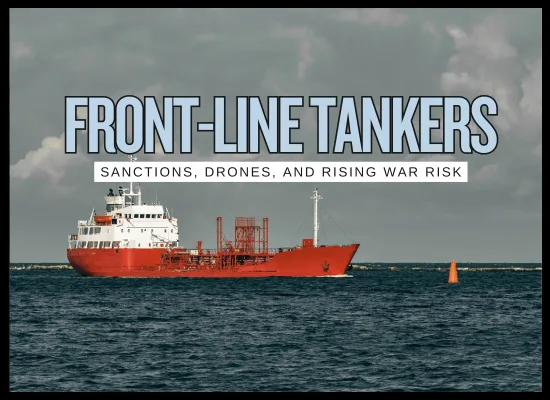
Shadow fleet risk is no longer just about regulators and paperwork. Drone campaigns in the Black Sea and missile attacks in the Red Sea have turned previously “cheap but opaque” tanker trades into front-line targets, while war-risk premiums and compliance screens are quietly reshaping what ships go where and at what price.
⏱️ 2-minute summary: shadow fleet collisions with reality ▶
Use this as a briefing sheet. Each row shows how a shadow fleet dynamic turns into real cost and risk for mainstream tanker owners and charterers.
In short, the shadow fleet is no longer a side story. It shapes war risk, insurance terms, enforcement intensity and the political response to the next casualty, which all feed directly into tanker P&L.
1️⃣
Drone war on the shadow fleet
Tankers as intentional targets in the Black Sea
▶
Ukraine now treats Russia’s shadow fleet as a legitimate target. Sea drones have repeatedly hit sanction linked tankers like Sig and, most recently, Dashan in Ukraine’s exclusive economic zone in the Black Sea, disabling the hull and briefly spiking war risk pricing in the region.
Risk pattern in 2025
- Sea drones are now used against merchant tankers, not only warships or port infrastructure, with several shadow fleet targets hit in quick succession.
- Many of these tankers run with AIS off, older hulls, limited class transparency and marginal insurance, so any hit can escalate quickly into a pollution or total loss event.
- War risk premiums for Black Sea voyages have risen as underwriters reprice the chance that a sanctioned hull or a misidentified ship is hit near busy routes.
How this bites owners and charterers
- Clean owners trading in or near the Black Sea see higher war risk quotes because underwriters price the whole area, not just the specific sanctioned hulls.
- Charterers and traders become more cautious about fixing tonnage with opaque ownership, flags of convenience or weak class that might be seen as “shadow linked”.
- Banks and financiers are more reluctant to support deals where a significant part of earnings depends on trades that could be interrupted by a drone strike or future sanctions.
Owner playbook
- Map exposure: list which ships, flags and corporate structures could be viewed as higher risk by insurers or regulators even if they are technically compliant.
- Work with brokers to compare war risk quotes for similar ships by area so you can see how much you are paying purely for geography and perceived “grey” exposure.
- Tighten policies on AIS use, routing near hotspots and documentation of compliant trades to show a clear separation from genuine shadow fleet activity.
2️⃣
Red Sea and Bab el-Mandeb war risk
Premiums and detours that no longer feel temporary
▶
Since late 2023, Houthi drone and missile attacks on commercial ships in the Red Sea and Gulf of Aden have moved war risk premiums from a marginal cost to a core voyage input. At peaks, additional war risk has reached around 0.7 to 1 percent of hull value for transits, and many owners have chosen to reroute via the Cape of Good Hope instead of using Suez.
Where the cost really comes from
- Extra war risk premiums per transit, often quoted as a percentage of hull value and payable up front for time in the listed area.
- Longer voyages and higher bunker bills when services detour around the Cape instead of using Red Sea and Suez.
- Higher security spend, including guards, equipment and route advice, plus schedule buffers to account for potential disruptions.
Operational impact on tankers
- Fixture negotiations now include explicit routing assumptions and who pays if a convoy is cancelled or a route has to change mid voyage.
- Some charterers refuse Red Sea routes for certain cargoes or brands, even if they remain technically insurable.
- Schedules become harder to keep stable, which affects fleet deployment, crew changes and maintenance planning across the network.
Owner playbook
- Maintain two voyage estimates for relevant trades: one via Suez and one via the Cape, with clear war risk, bunker and time differences.
- Capture data on how often routes are actually diverted, then treat this as a structural budget line instead of a one off exception.
- Align charterparty clauses, insurance cover and bank covenants so that all three reflect the same view of Red Sea and Bab el Mandeb risk.
3️⃣
EU vessel blacklist and port bans
Shadow fleet hulls losing access to ports and services
▶
Recent EU sanctions packages now name specific tankers that move sanctioned oil outside the price cap and bar them from EU ports and crucial maritime services. That shift treats these tankers not only as higher compliance risk but as vessels that may never again trade in mainstream markets if restrictions stick.
What the blacklist changes in practice
- Named tankers lose direct access to EU ports and often lose key services such as classification, insurance, bunkering and repairs from EU based providers.
- Even ships that are not named but follow similar trade patterns can face heavier screening or informal reluctance from banks, clubs and service providers.
- The market starts to treat some hulls as “terminally grey” which reduces resale options and makes them harder to redeploy to clean trades later.
How this spills into the wider tanker market
- Removal of even a few dozen large crude or product tankers from mainstream support networks tightens supply for compliant trades and supports higher day rates.
- Charterers become more selective, preferring younger and fully transparent ships that are unlikely to be added to future lists.
- Owners with mixed fleets feel pressure to demonstrate clear separation between clean and sanctions exposed entities, banks and technical platforms.
Owner playbook
- Run a simple “sanctions fitness” review per vessel that looks at flag, ownership, historic voyages and counterparties and compare it with current EU and G7 guidance.
- If any hull depends heavily on sanctioned or high risk trades, model what happens to your balance sheet if that ship suddenly loses port and service access in key regions.
- Use the threat of future listings to support internal arguments for younger fleet profiles, cleaner trades and better voyage documentation.
4️⃣
Price cap enforcement 2.0
Tighter documentation and higher stakes for evasion
▶
The original oil price cap relied heavily on self declared attestations and spot checks. Newer enforcement rounds ask for more detailed paperwork, cross checking of bills of lading and payment chains and impose penalties on service providers that ignore warning signs, not only on the ship or cargo owners themselves.
Where cap pressure shows up for tankers
- More frequent requests from insurers, P&I clubs and banks for trade level information, including invoices and proof that cargoes were sold below the official price cap.
- Higher operational cost when voyages that looked profitable on headline freight must carry the admin burden of documenting price cap compliance.
- Sharper consequences when documents are missing or inconsistent, including withdrawal of cover, frozen payments or retroactive sanctions exposure.
Impact on shadow versus compliant fleets
- Truly shadow operators move further into non Western services, less transparent finance and older hulls that accept higher safety and pollution risk.
- Compliant owners that touch borderline trades face a choice: either accept the full compliance workload or exit those routes entirely.
- The effective cost of doing grey business rises as more entities in the facilitation chain demand proof that they are not funding evasion.
Owner playbook
- Treat price cap documentation as part of voyage planning, not an afterthought at the claims stage. Decide who collects and stores which proofs per trade.
- Ask brokers, banks and insurers clearly what evidence they expect for trades that are close to cap thresholds and build that into charterparty language.
- Run a scenario where a particular trade is later judged non compliant and stress test what that would mean for insurance, finance and access to future business.
5️⃣
Aging and under-insured tankers
When shadow fleet safety becomes a market wide risk
▶
A large slice of the shadow fleet consists of older crude and product tankers that mainstream owners would normally sell or scrap. Some operate with limited class transparency, patchy survey histories and non standard insurance. When those ships trade near busy routes or environmentally sensitive coasts, the safety gap becomes a risk for everyone, not only the beneficial owner.
What this part of the fleet looks like
- Many shadow linked hulls are older than 15 years and in some cases more than 20, ages where many mainstream operators have already exited.
- Frequent changes of flag, ownership and technical manager make it harder to track real condition and accountability over time.
- Some ships rely on lower tier insurers or alternative risk arrangements, with less comfort for coastal states that worry about a major spill.
Why this raises risk for the whole market
- If an older, poorly maintained tanker fails in a chokepoint or near a major port, closures and diversions affect compliant ships as well.
- A high profile casualty linked to sanctions evasion can trigger political pressure for wider crackdowns that hit ordinary trades.
- Insurers and banks react to incidents by tightening terms across whole regions or ship types, not only for the one operator involved.
Owner playbook
- Classify your own fleet by age, condition and trade so you can clearly show which ships sit in the top risk tiers for structure and machinery.
- For any older hulls you still operate, document maintenance and survey quality in a way that is easy for banks, charterers and regulators to review.
- Use shadow fleet accident scenarios in board and risk committee discussions so capital plans reflect the chance of tighter rules after a major spill.
6️⃣
AIS dark and GPS disturbed trading
Navigation risk in the grey zone
▶
To avoid sanctions monitoring or drone targeting, some shadow fleet tankers routinely switch off AIS, spoof locations or operate in zones where GPS interference is common. That makes enforcement harder, but it also raises the chance of collision, grounding or misidentification in busy lanes that still carry a lot of fully compliant traffic.
How AIS dark patterns emerge
- Ships go dark while loading or conducting ship to ship transfers in known sanctions sensitive areas, then reappear with new declared cargo or destination.
- Some operators use position spoofing that places the ship in a different sea, which confuses tracking tools and compliance teams.
- In conflict zones, GPS jamming and spoofing can affect even compliant ships that try to keep their transponders on, adding another layer of uncertainty.
Practical risk for navigation and compliance
- Bridge teams cannot rely fully on AIS pictures in areas where several ships manipulate or suppress signals, which raises collision risk.
- Coastal states and navies may struggle to distinguish between compliant and non compliant targets in real time, especially during incidents.
- Owners that allow unexplained AIS gaps face more questions from banks, charterers and clubs, even if no sanctions rules were broken.
Owner playbook
- Set clear internal rules for AIS use that define when and why a signal can be switched off and how it must be documented.
- Use independent tracking and anomaly detection tools to monitor your own fleet so you can address unexplained dark periods quickly.
- Include AIS behaviour and GPS interference scenarios in bridge and VTS drills, especially for ships that trade near conflict areas or chokepoints.
7️⃣
Sanctions climbing the facilitation chain
From traders and insurers to the hull in the water
▶
Regulators are no longer focused only on the ship and cargo owner. Recent packages increasingly target the facilitators behind grey trades, such as traders, logistics firms, ship managers, brokers and even IT providers. That widens the circle of entities that can be penalised and makes it harder for shadow activity to hide behind apparently clean front companies.
Who is now firmly in scope
- Commodity traders and intermediaries that arrange flows of sanctioned oil using complex corporate structures and payment chains.
- Technical and commercial managers that operate ships on behalf of opaque owners with weak transparency on ultimate beneficiaries.
- Insurers, P&I clubs, banks and leasing houses that continue to support suspect trades after receiving official red flags.
How this reshapes tanker risk
- Service providers are quicker to exit relationships that feel even slightly shadow linked, which can leave a tanker suddenly without cover or finance.
- Legitimate owners partnering with the wrong trader or pooling structure can inherit sanctions concerns even if their own ships are clean.
- Charterers and banks push for deeper due diligence on counterparties which slows deal making and raises transaction cost for marginal cargoes.
Owner playbook
- Map your exposure by listing principal traders, banks, insurers and managers you rely on, then benchmark them against recent designations and advisories.
- Build a simple internal rule that you will exit trades where a key counterparty appears in official red flag lists, even if the ship itself is not named.
- Make facilitation risk part of board level reporting so deals that depend heavily on borderline counterparties get explicit scrutiny.
8️⃣
War risk and P&I repricing
When careful owners pay for reckless behaviour
▶
Drone strikes, missile attacks and sanctions related incidents are not contained to shadow tonnage. Underwriters often respond to high profile losses by repricing whole regions or ship classes. The result is that careful, compliant owners can face higher war risk and P&I costs because of incidents that originated in riskier parts of the market.
Where the extra cost appears
- Increased additional war risk premiums for transits through listed areas such as the Red Sea, Black Sea and parts of the Eastern Mediterranean.
- Higher deductibles, tighter exclusions and more detailed questionnaires for tankers that trade near sanctions sensitive regions.
- Rising reinsurance costs for clubs and hull underwriters that eventually pass through to fleet level premiums.
Impact on day to day decisions
- Marginal trades that only just cleared hurdle rates can become uneconomic once revised war risk and P&I terms are applied.
- Owners may choose to avoid certain areas entirely which removes supply and supports higher freight rates on alternative routes.
- Charterers start distinguishing between fleets based on safety track record and transparency, not only on headline rate.
Owner playbook
- Work closely with brokers to understand how much of your premium reflects general regional risk versus your own fleet history and practices.
- Use conservative assumptions for additional war risk in budgets and voyage estimates so that higher charges do not come as a surprise.
- Showcase safety investments, transparent trading patterns and conservative routing decisions when negotiating renewals with clubs and insurers.
9️⃣
Shadow fleet supply removal
Higher day rates with thinner safety margins
▶
As more shadow fleet tankers are hit by sanctions, port bans or physical damage, a chunk of crude and product capacity is effectively removed from mainstream hire. That pushes utilisation up and supports higher day rates, but it also means that the ships still trading in the grey zone do so with even weaker oversight, which raises the risk of sudden disruption.
How supply and rates are affected
- When shadow linked ships lose access to key ports or services, they become less useful for mainstream cargoes and may only trade in narrow corridors.
- Fewer practical ships in the global pool mean higher utilisation for compliant fleets, which can lift earnings across several tanker segments.
- Volatility increases because additional sanctions packages or incidents can suddenly remove another slice of capacity overnight.
The risk that comes with tighter supply
- Traders and charterers with urgent cargoes may accept weaker safety or compliance standards if the choice is limited to grey tonnage.
- Higher rates can mask the underlying fragility of trades that depend on ships which could be listed, detained or damaged without much warning.
- Markets can swing quickly if regulators choose to tolerate shadow flows during a tight oil period, then clamp down again later.
Owner playbook
- Treat today’s higher earnings as partly driven by removal of marginal supply and avoid assuming current rates will last through a full cycle.
- Use the current window to strengthen balance sheets, renew fleets and exit trades that rely on questionable counterparties or routes.
- Track how much of your revenue comes from trades that would suffer the most if another round of shadow fleet restrictions hits.
🔟
Pollution and liability tail risk
When a dark tanker fails in the wrong place
▶
A serious spill or casualty involving a shadow fleet tanker in a chokepoint or near a major coastline would not only be an environmental disaster. It would also trigger difficult questions about who pays when ownership is opaque, cover is thin and the ship was trading outside normal transparency rules. That tail risk hangs over the entire industry, not just the names on a sanctions list.
What a worst case incident looks like
- An older tanker carrying heavy crude or fuel oil grounded or hit in a narrow strait or near a busy port with strong currents and limited response capacity.
- Slow or disputed claims handling because the beneficial owner is hard to identify and insurance arrangements are unclear or contested.
- Coastal states, clubs and mainstream owners facing pressure to fund clean up and compensation when the responsible party cannot or will not pay.
How liability spills into the wider sector
- Reputational damage that affects the public view of tankers in general, which can drive new restrictions and costs for compliant fleets.
- Tighter vetting and approvals for all ship types calling sensitive coasts, with more inspections, paperwork and delays.
- Higher contributions and call levels across P&I clubs if the system has to absorb very large losses from poorly insured ships.
Owner playbook
- Engage with industry bodies and clubs that are pushing for clearer standards on tracking, insurance and liability for high risk trades.
- Make your own spill prevention and response capabilities visible to charterers and financiers, especially on older tonnage that you still operate.
- Use internal risk pricing that reflects the potential long tail of pollution and liability when evaluating short term gains from marginal trades.
Taken together, these ten pressure points show how the shadow fleet has moved from a quiet footnote in sanctions briefings to a core driver of tanker risk, pricing and policy. For ship and fleet owners, the choice is no longer just whether to touch grey trades or stay away. It is about understanding how drone attacks, tighter enforcement and weaker safety standards in the shadows ripple into war risk premiums, charterer expectations, regulatory responses and the long tail of liability across the entire market.