Exhaust Gas Cleaning Systems Made Simple: 2026 Update
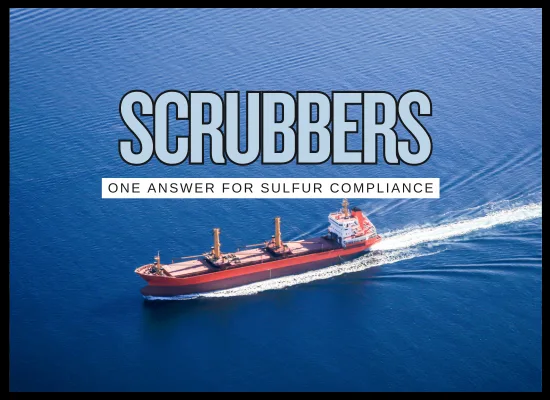
Exhaust gas cleaning systems (EGCS), better known as scrubbers, are the “sulfur compliance plumbing” bolted onto a ship’s exhaust. They let operators keep burning higher-sulfur fuel while still meeting SOx emission limits by cleaning the exhaust gas before it leaves the funnel. That matters because the global sulfur limit is 0.50% m/m outside ECAs (since Jan 1, 2020) and 0.10% m/m inside ECAs. Scrubbers are recognized as an “equivalent” compliance option under MARPOL Annex VI, but the tradeoff is extra equipment, power draw, residues, and increasing attention on washwater discharge rules

What is it and Keep it Simple...

Exhaust Gas Cleaning Systems (Scrubbers) are like a built-in “smokestack car wash” for a ship’s exhaust. Instead of switching to low-sulfur fuel, the ship keeps burning conventional fuel and the scrubber removes sulfur oxides (SOx) from the exhaust before it exits the funnel.

There are three common setups: Open-loop uses seawater to wash the exhaust and discharges the washwater overboard, closed-loop recirculates freshwater with an alkaline additive and produces a treated bleed-off plus stored residues, and hybrid can switch between modes depending on where the ship is operating. The business decision usually comes down to fuel price spread, trading pattern, discharge restrictions, and how much operational complexity the owner is willing to carry.

Exhaust Gas Cleaning Systems (Scrubbers): Advantages and Disadvantages
Category Advantages Disadvantages Notes / Considerations
SOx compliance Meets sulfur emission limits while continuing to burn higher-sulfur fuel Compliance depends on correct operation, monitoring, and maintenance Treat it like safety equipment: alarms, spares, logs, and audits matter
Fuel economics Potential savings when HSFO is meaningfully cheaper than VLSFO/MGO Payback risk if fuel spreads narrow or trading shifts Model by route, ECA time, and expected spread volatility
Operational complexity Clear procedures can make operation routine on repeat trades More pumps, sensors, valves, and automation means more failure modes The human factor is real: changeovers and troubleshooting drive outcomes
Washwater restrictions Hybrid/closed-loop can keep options open where discharge is restricted Open-loop discharge limits are expanding in some ports/sea areas Your value case can break if key ports require compliant fuel instead
Power and fuel penalty Usually manageable on vessels with adequate auxiliary margin Pumps and treatment load add electrical demand and some fuel burn Include kW draw in the ROI, especially at high flow in open-loop mode
Space and retrofit impact Can be installed during scheduled yard windows with planning Large equipment footprint, added weight, and routing complexity Funnel casing, washwater piping, and tanks can create knock-on changes
Waste and residues Closed-loop can limit overboard discharge and keep residues contained Residues, sludge, filters, and bleed-off handling add logistics and cost Plan storage, landing ashore, and documentation like any waste stream
Maintenance and reliability Predictable upkeep with disciplined water chemistry and spares Corrosion, scaling, sensor drift, and valve wear can cause downtime Owners that win have strong PM routines and clear fault playbooks
Environmental tradeoff Cuts SOx and can reduce some particulate matter at the exhaust Does not reduce CO2, and washwater concerns drive regulatory pressure Scrubbers solve sulfur compliance, not decarbonization strategy
Commercial acceptance Some trades and charterers accept scrubber-fitted ships routinely Some cargo owners/charterers prefer low-sulfur fuels or have policies Check charter party clauses: who pays fuel, compliance risk, and delays
Summary: Scrubbers are a fuel-flexibility play for SOx compliance. They can pay when the fuel spread is strong and the operating area allows your chosen discharge mode. The downside is added machinery, power draw, residue handling, and growing washwater restrictions that can force mode changes or compliant fuel use.

2025 EGCS (Scrubbers): What’s Really Working

  • Compliance evidence is clean and consistent: The ship can show stable readings and records that align with the approved scheme, with fewer “mystery” gaps during audits, port calls, or crew changes.
  • Mode and fuel switching is routine, not chaotic: Where washwater discharge is restricted, the ship has a predictable playbook for switching mode or burning compliant fuel without last-minute confusion or delays.
  • Water chemistry stays in control: Crews are not constantly chasing alarms from sensors and water treatment, and calibration is treated like a reliability task, not a paperwork task.
  • Residue logistics do not surprise the operator: Sludge, filters, and any stored effluent have predictable generation rates and offload plans, and tank capacity is not routinely pushed to the edge.
  • Reliability is driven by maintenance discipline: Corrosion, scaling, blocked nozzles, worn valves, and pump issues are managed with spares, planned upkeep, and clear fault isolation steps.
  • Fuel savings survive real-world friction: The actual saved dollars still look reasonable after subtracting power draw, consumables, offloads, maintenance, and the fuel burned when the scrubber cannot be used.
  • The failure plan is understood onboard: If the EGCS fails to meet requirements or instruments fail, the response is consistent and documented, rather than improvised mid-voyage.
EGCS (Scrubber) — Fuel Spread Economics, Payback, NPV
Adjust to match your trade and ports
Fuel and Trading Pattern
Power Penalty (Pumps, Fans, Treatment)
Costs (CAPEX and Annual OPEX)
Policy Stress Test
Fuel spread (VLSFO - HSFO)
-
Effective compliant fuel share
-
Annual gross fuel savings
-
Annual power penalty cost
-
Annual OPEX (maint + sensors + residues + chem)
-
Net annual benefit
-
All-in CAPEX (incl. off-hire)
-
Payback (years, discounted)
-
NPV / IRR
-
This model focuses on economics of fuel spread versus scrubber costs and operating friction. It does not price reputational pressure, charterer clauses, or enforcement outcomes. Use it as a disciplined “what must be true” test, then replace defaults with quotes and real consumption data.

Scrubbers remain a straightforward answer to a specific problem: sulfur compliance. Where they get complicated is everything around that core mission, including washwater discharge limits, equipment reliability, residue handling, and how charterers and ports respond. In practice, the winning scrubber story looks boring: stable monitoring, predictable changeovers, controlled OPEX, and savings that still pencil out after restrictions and downtime are counted.

We welcome your feedback, suggestions, corrections, and ideas for enhancements. Please click here to get in touch.
By the ShipUniverse Editorial Team — About Us | Contact