Cable Management Systems for Ships (CMS): 2026 Guide
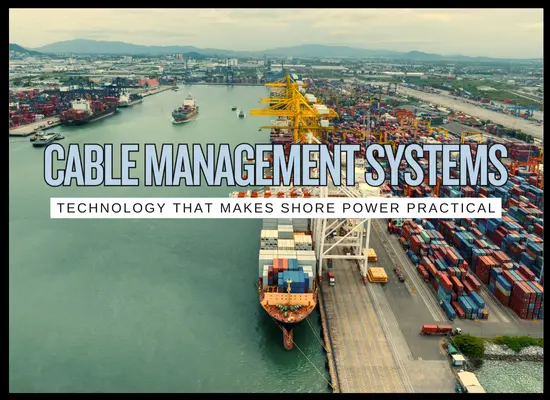
Cable Management Systems (CMS) are the “last 30 meters” technology that makes shore power practical. You can have a fully compliant shore connection on paper, but if the cable handling is slow, heavy, or unsafe, crews avoid using it. Going into 2026, the real progress is more automation (arms/robots/reels), better safety interlocks, and designs that reduce manual handling time at the berth.
What is it and Keep it Simple...
A cable management system for ships is the equipment that stores, pays out, positions, protects, and retrieves the shore power cable during connection and disconnection at berth. It is the “handling system” that turns shore power from a theoretical capability into something crews can do quickly, safely, and consistently.
On the ship side, this can be a reel, a guided tray system, a crane-assisted deployment, or a socket/plug arrangement designed so the crew does not fight the cable. On the berth side, it might be a gantry, telescopic arm, robotic connector, or reel system that brings the cable to a predictable connection point with controlled tension and protection.
- A faster, repeatable shore power connection routine (less variability by crew)
- Lower damage risk to cables, plugs, and sockets (and fewer connection failures)
- Better safety: reduced manual cable handling and controlled tension/positioning
- Higher shore power “usage rate” because it is less annoying to do
| Category | Advantages | Disadvantages | Notes / considerations |
|---|---|---|---|
| Safety and handling | Less manual lifting and fewer “pinch / crush / trip” situations during connection and retrieval. | Poor layouts can still force awkward handling, especially if the connection point is badly placed. | Design around how crews actually work at night, in rain, and under time pressure. |
| Connection speed | Faster hook-up and disconnect supports higher shore power usage rates and fewer delays at berth. | Some systems add steps (locks, checks, alignment) that can feel slow if procedures are unclear. | Time the full routine: from “ready” to “power on,” not just physical plug-in. |
| Reliability | Controlled tension, guided routing, and protection reduce cable damage and connector failures. | Mechanical complexity adds maintenance points (reels, arms, brakes, sensors). | Ask for spares strategy and a clear degraded-mode plan if the CMS fails. |
| Compatibility | Better chance of consistent results when aligned to established shore connection standards and interface practices. | Ports vary: connection location, voltage, frequency, and berth geometry can still drive customization. | Map your main ports first, then decide whether ship-side, shore-side, or hybrid CMS makes sense. |
| Space and retrofit | Modern reels and integrated arm concepts can fit tighter spaces than older “manual cable storage” approaches. | Retrofit can be painful: structural supports, cable runs, fire boundaries, and safe access routes. | Do a real install study: route, weight, access, and watertight boundaries. |
| Human error reduction | Interlocks and guided positioning reduce wrong-sequence actions and connector mishandling. | If interlocks are too strict or confusing, crews will bypass procedures. | Make the process obvious: clear indicators, simple sequencing, and easy training. |
| Maintenance burden | Less cable damage can lower replacement frequency and reduce hidden repair time. | Reels/arms/controls need inspection, lubrication, and periodic testing. | Put maintenance in PMS with short checks (visual, brake test, limit switches). |
| Operational confidence | When the routine is smooth, crews are more likely to use shore power consistently. | If the first few connections are messy, shore power adoption stalls even if the ship is technically capable. | Start with a “first 10 calls” rollout plan: coach, log issues, adjust, then standardize. |
2026 CMS: what’s really working at the berth
Extra plugged-in hours per year
0
Gross annual value
$0
Annual net benefit
$0
Simple payback
n/a
A CMS project is successful when it increases shore power usage without adding drama. If your average connection time drops, aborted connections fall, and the crew stops “dreading the cable,” you will see the real payoff: more hours plugged in and fewer damaged connectors and near-miss handling situations. For 2026 planning, the direction is clear: ports and operators are treating shore power as routine, and suppliers are booking systems that include cable reels and management gear with deliveries extending into 2026.
We welcome your feedback, suggestions, corrections, and ideas for enhancements. Please click here to get in touch.