AI Collision Avoidance for Ships: 2026 Guide
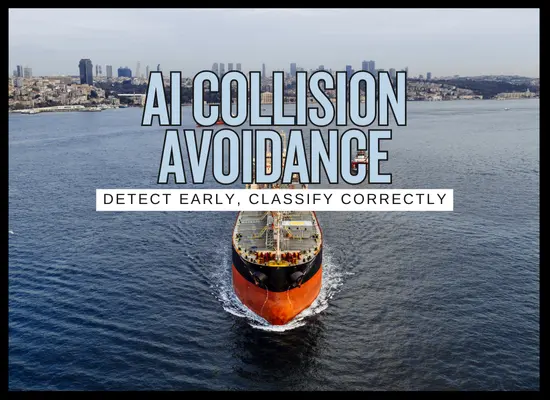
AI collision avoidance is basically the industry’s attempt to turn “what the bridge team already does” into a more consistent, less fatigue-sensitive process: detect early, classify correctly, fuse sensor inputs, and suggest COLREG-aware actions without flooding the watch with noise. Going into 2026, the biggest step-change is networked awareness + better sensor fusion, not just smarter cameras.
What is it and Keep it Simple...
AI collision avoidance is software that helps a bridge team detect targets sooner, understand what matters next, and reduce close-quarters surprises. It does this by processing sensor inputs (often camera and thermal, plus radar and AIS) and turning them into prioritized prompts, warnings, and suggested maneuvers that fit practical watchkeeping.
The “AI” part is not one magic button. It is a chain: detection (find objects), tracking (follow motion), classification (what is it), risk scoring (does it matter), and decision support (what action is reasonable). The goal is not to replace COLREG judgement. The goal is to reduce missed detections and late recognition.
- Earlier detection of small or low-visibility targets in busy water
- Faster clarity when camera view, radar picture, and AIS do not line up
- Reduced watch fatigue by highlighting what is most relevant now
- A stepping stone for remote operations and autonomy programs
| Category | Advantages | Disadvantages | Notes / considerations |
|---|---|---|---|
| Early detection | Helps spot small, low-contrast, or poorly lit targets earlier, especially with thermal + AI. | Dirty lenses, glare, spray, and poor mounting can drop performance fast. | Placement and cleaning access are not details. They decide whether the system earns trust. |
| Risk prioritization | Turns a crowded picture into a shorter “watch list” so the bridge focuses on the next decision. | Bad tuning can create alert fatigue, causing crews to mute or ignore prompts. | Start conservative; tune by segment (harbor, coastal, ocean) and review alerts weekly. |
| Sensor fusion | Cross-checking camera detections against radar/AIS can reduce blind spots and confusion. | Overlay without logic can mislead if confidence, tracking, or priorities are unclear. | Ask how the system behaves when sensors disagree, and how it communicates uncertainty. |
| COLREG workflow fit | Decision support can reinforce disciplined early action and reduce “late, sharp” maneuvers. | There is a real risk of over-trust or misunderstanding what the AI is recommending. | Train it as assistive. The watch still owns COLREG compliance and the final maneuver. |
| Evidence and learning | Recorded detections/video support near-miss learning, training, and bridge procedure improvement. | Data retention and cybersecurity controls must be handled properly. | Set clear retention and access policy and treat it as part of the ship’s cyber posture. |
| Commercial maturity | More systems are packaged and networked, moving beyond isolated onboard tools. | Capability claims vary by vendor and environment; trials matter. | Test at night, in rain/haze, and in your busiest water before fleet rollout. |
| Path to autonomy | Perception + decision support modules are building blocks for remote ops and autonomy. | Autonomy acceptance depends on the full safety case, not vision alone. | Use AI collision avoidance to improve today’s bridge routine while future-proofing. |
2026 AI collision avoidance: what’s really working
Optional finance settings (NPV horizon + discount)
Annual time value (program)
$0
Annual event value (program)
$0
Annual net benefit
$0
Payback (years)
n/a
NPV (program)
$0
Events avoided per year
0
AI collision avoidance succeeds when it makes the bridge routine calmer and earlier, not louder and later. In real rollouts, the clearest win is fewer “uncertainty slowdowns” during crowded or low-visibility situations, plus a measurable drop in close-quarters events that turn into paperwork, claims, or operational disruption. If you want a conservative evaluation, set minutes saved low, keep event reduction in single digits, and see if payback still holds. If it does, you are probably looking at a system that’s being used correctly, not just installed.