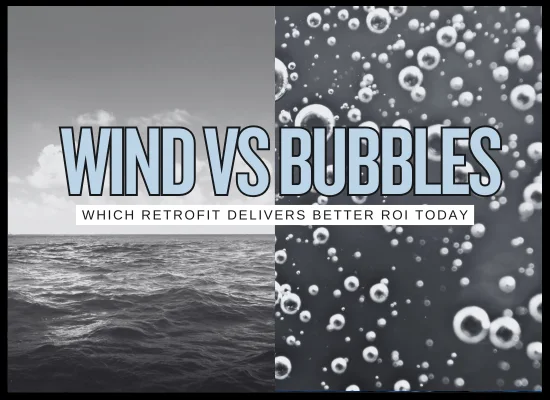
Two groundbreaking technologies are reshaping ship budgets in 2026. Both with one simple goal, to save fuel. One spreads a cushion of bubbles under the hull to cut friction. The other captures wind with spinning cylinders to add thrust. This report puts both in plain language so you can judge what each really is and why it changes fuel burn, CO₂, and cash flow.
Rotor Sails: Quick Tech Summary
Rotor sails are tall spinning cylinders fitted on deck. When the ship meets suitable wind, the cylinders generate lift that helps push the vessel forward. The main engine can do the same job with less power, which lowers fuel use and CO₂ on wind-friendly legs.
Benefits
Can deliver strong savings on windy routes.
No hull penetrations. Deck based equipment.
Works alongside voyage and speed planning.
Constraints
Needs deck space and crane or hatch clearance.
Benefit varies with wind direction and strength.
May affect port operations and line of sight.
Air Lubrication: Quick Tech Summary
Air lubrication releases a controlled layer of microbubbles under the flat of bottom. The bubble carpet reduces skin friction between water and hull. With less drag the ship needs less propulsive power to hold speed, which cuts fuel and CO₂ on steady passages.
Benefits
Works on routes with variable or light winds.
Provides steady savings at consistent service speed.
Applies to many large hulls with broad flat bottoms.
Constraints
Parasitic power draw from compressors and blowers.
Performance depends on bubble coverage and speed.
Additional equipment to monitor and maintain.
Cost • Install • Maintenance
This section grounds the comparison in real numbers. You’ll see current, publicly reported ranges for capex, yard time, and routine upkeep for rotor sails and air lubrication. Treat the figures as directional since results vary by hull form, system size, and project scope. Confirm with vendor quotes and a class-aligned measurement plan before committing.
Rotor Sails
Reported capex
€1–3m per ship
varies by sail size/count
Hook-up time
6–12 h per sail
foundations prepped
Verified saving
8.2% over a year
LR-verified trial
Cost
Public ranges cluster around €1–3m per ship depending on cylinder count and size. Recent modeling often uses €2.0m per device + €0.1m install as a base input for payback analysis. Some operators use 5 year fixed-fee leasing to reduce upfront cash.
Install
Foundations and cabling are planned into a scheduled drydock, typically within 7–14 days depending on steel scope. With foundations ready, the final lift, mechanical connection, electrical hook-up and commissioning are commonly completed in 6–12 h per sail. Multi-sail projects sequence lifts across the same docking.
Maintenance
Expect routine inspections of the drive unit, bearings and control system, plus periodic lubrication and visual checks of cylinders and guys. Vendors offer global service programs and remote monitoring. For performance, many operators schedule on/off periods and normalize data for weather and route under class recommended practice for wind-assist systems.
Air Lubrication
Reported capex
€0.8–2.0m
size and coverage
Retrofit drydock
~6–30 days
scope dependent
Verified trial saving
4–5% net
MR tanker trials
Cost
Trade interviews place full systems at about €0.8–2.0m depending on compressor size, piping runs and bubble coverage. Industry coverage commonly frames typical net savings in the 5–10% range when coverage and speed profile are well matched.
Install
Repeat retrofits are often engineered and approved within about 20–24 weeks from order. The drydock portion can be completed in as little as 6 days on repeat scopes with pre-fabricated piping and release units. Other public examples show total yard time around 10–30 days depending on hull area, piping runs and inspections, usually aligned with a planned drydock.
Maintenance
Plan routine service for compressors or blowers, air-release units and control valves, plus monitoring of bubble coverage. Net performance is evaluated after subtracting compressor power. Class briefs outline evaluation methods and many operators run long-run monitoring to confirm savings across seasons.
These are indicative ranges from public sources. Validate with quotes, class approvals and a measurement plan before committing.
📊 Who Wins
Rotor sails tend to lead on wind-exposed legs with reliable beam or quartering winds, especially when routing and speed choices align with seasonal wind windows. Air lubrication tends to lead on long, steady-speed passages and on hulls with a broad flat-of-bottom where bubble coverage stays consistent. Map these tendencies to your lanes, speeds, and vessel layout before running ROI.
Rotor Sails
Wind-exposed routesBeam or quartering windsVoyage optimization synergy
Operating profile
Wins on legs with frequent sideways or quartering winds where apparent wind can be harvested for many sea days.
Planning routes and speeds to meet wind windows increases the effect.
Vessel and speed tendencies
Common on bulkers, product tankers, ro-ro and selected container designs with adequate deck clearance.
Benefit is steady at moderate service speeds and rises when wind exposure is good.
What it depends on
Wind exposure
Route planning
Port and crane clearance
ROI triggers
Core lanes with reliable wind seasons.
Charter or owner control over routing and speed.
Exposure to CO₂ cost where avoided emissions carry cash value.
Watchouts
Deck footprint and air draft constraints near cranes and hatches.
Benefit varies more on calm or headwind-heavy routes.
Bridge sight lines and port compatibility must be considered.
Air Lubrication
Steady service speedsLarge flat-of-bottomBase-load drag reduction
Operating profile
Wins on long passages at consistent speeds where a bubble layer can cover most of the flat-of-bottom for many hours.
Provides a steady baseline saving irrespective of wind conditions.
Vessel and speed tendencies
Frequent on LNG carriers, large container ships and cruise, with growing use on bulkers that run predictable schedules.
Works best when speed does not swing widely during the voyage.
What it depends on
Steady speed
Bubble coverage
Parasitic power management
ROI triggers
High annual sea days at consistent speed.
Large wetted area with broad flat-of-bottom.
Fuel and CO₂ exposure where small percentage cuts compound over distance.
Watchouts
Compressor power reduces gross saving; evaluate net effect.
Coverage and release-unit layout must match hull geometry.
Performance can drift if hull roughness increases between dockings.
This matrix is a practical guide. Confirm fit with your routes, deck or hull constraints and a class-aligned measurement plan.
🧮 ROI Calculator
Advanced
Example MR at 12 to 14 kn
2025 phase. 100 intra EU. 50 extra EU.
Measured at cruise
Varies with coverage
Rotor Sails
Annual cash benefit (net)
€0
CO₂ avoided
0 t
Payback
n/a
Air Lubrication
Annual cash benefit (net)
€0
CO₂ avoided
0 t
Payback
n/a
Sensitivity — annual cash benefit by saving percent
Rotor Sails
Air Lubrication
Assumptions: emission factor 3.114 tCO₂ per t fuel. Generator SFC 0.2 kg per kWh for parasitic loads. All values are editable.
Rotor sails and air lubrication are both real, money-saving tools, but the right choice depends on your lanes, speed profile, hull layout, and yard timing. If your trades are wind-rich and you control routing and speed, rotor sails can deliver strong net cuts with relatively light parasitic load. If your ship runs long, steady legs with a broad flat-of-bottom, air lubrication provides a dependable base saving that compounds over distance. Price your actual fuel and CO₂ exposure, insist on a class-aligned M&V plan with on/off periods, and demand net figures that include parasitic power and maintenance. Run a pilot on one hull, confirm the data over a full season, then scale only where the payback is proven.