Naval Cybersecurity in 2026: 12 Platform Cyber Risks Buyers Are Pricing In
February 24, 2026
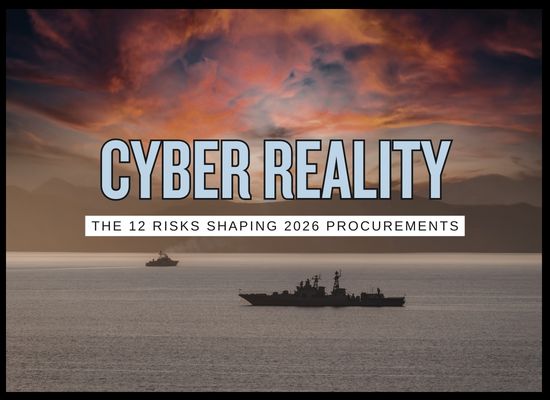
Naval buyers are pricing cyber risk differently in 2026 because ships now run blended environments: traditional IT, mission networks, and operational technology that controls real equipment. The questions are getting more specific, especially around zero trust for OT, control-system vulnerability management, and how fast a fleet can patch and re-accredit without breaking operations.
Naval Cybersecurity in 2026
12 platform cyber risks buyers are pricing in
| # | Platform cyber risk | Showing Up | Buyers ask for in 2026 | Pricing signal |
|---|---|---|---|---|
| 1 |
IT and OT bleed-through
Enterprise IT paths accidentally reach machinery and control networks.
|
Remote admin tools, shared services, or “temporary” bridges create unintended routes into control systems. Over time, exceptions become permanent and documentation drifts from reality.
Recent DoD and DON direction has sharpened attention on zero trust in OT environments and practical implementation activities, which pushes this risk higher on checklists.
|
Network segmentation evidence, allowed pathways, and how identity is enforced across boundaries. Buyers also ask whether OT systems can operate safely if IT is isolated during an incident.
OT zero trust guidance and DON zero trust planning language are increasingly referenced in acquisition discussions.
|
High cost exposure Rework risk Design driver |
| 2 |
Control system vulnerability management gaps
Findings exist, but corrective actions lag or ownership is unclear.
|
Vulnerabilities are identified during assessments, but remediation stalls because funding, responsibility, or authority is disputed. That creates long-lived exposure in building controls, industrial controls, and other OT-like environments.
A DoD Inspector General audit flagged insufficient DON guidance to ensure corrective actions were taken for control-system vulnerabilities, highlighting how governance can be the limiter.
|
A closed-loop remediation process with named owners, funding path, prioritization rules, and proof of closure. Buyers want to know how quickly “critical” findings are actually fixed, not just documented. | Recurring liability Schedule drag Oversight risk |
| 3 |
Identity and privileged access sprawl
Too many admin accounts, shared credentials, and weak separation of duties.
|
Ships accumulate vendor accounts, temporary maintainer logins, and shared admin practices during availabilities. Over time, the identity map becomes opaque and incidents become harder to contain.
Zero trust implementation guidance and DON planning emphasize identity as a core control, which makes this a top buyer question.
|
Privileged access management approach, auditability, account lifecycle controls, and how identities are handled in disconnected operations. Buyers want clear answers on “who can do what, from where, and how it is logged.” | Higher sustainment cost Incident severity Compliance |
| 4 |
Patch and update reality in disconnected operations
Security updates collide with uptime demands, bandwidth limits, and recertification cycles.
|
Even when patches are available, applying them on deployed platforms can be constrained by maintenance windows, test requirements, and accreditation timelines. Delays leave known issues open longer than intended.
DoD policy actions to implement zero trust and convert guidance into formal instruction add pressure for disciplined, repeatable update governance.
|
A ship-ready patch pipeline: staging, regression testing, rollback plans, and how updates are validated without breaking mission systems. Buyers ask for evidence of cadence, not promises. | Lifecycle cost Exposure window Program risk |
| 5 |
Supply chain software and firmware risk
Opaque third-party code, unclear provenance, and weak visibility into components.
|
Combat systems, navigation, mission payloads, and support applications may include multiple third-party elements. Without strong visibility, a single vendor issue can become a fleet-wide problem.
Zero trust planning inside the Department of the Navy reinforces emphasis on visibility and control over users, devices, and workloads across environments.
|
Software bill of materials posture where applicable, vendor vulnerability disclosure process, update responsibility split, and data rights to logs and telemetry that support investigation. | Fleet-wide risk Warranty clauses Data rights |
| 6 |
Training and procedural drift in cyber hygiene
Human behavior and watch routines become an attack surface.
|
High tempo operations and maintenance periods can degrade routine practices: removable media discipline, configuration control, and incident reporting speed. Over time, “workarounds” become normal.
The Department of the Navy continues to publish cybersecurity policy and guidance, including structured awareness and training requirements, reinforcing buyer focus on human factors.
|
Defined training and certification expectations, role-based access tied to qualifications, and how the program verifies compliance onboard. Buyers ask how fast a ship can detect, report, and isolate an event. | Operational risk Incident likelihood Low-cost fixes |
| 7 |
Remote maintenance pathways and contractor toolchain access
Distance support and “reach-back” troubleshooting reduce downtime, but expand the trust boundary.
|
Shipboard networks increasingly rely on remote support methods and contractor-enabled diagnostics to speed repairs and reduce travel. That can introduce new identity, session control, and logging requirements, especially when ships are operating with intermittent connectivity or under mission constraints.
Buyers are noticing that faster support can also create new privileged-access and “who touched what” audit questions.
|
A remote-access governance package: named roles, time-bound approvals, privileged access controls, tamper-evident logs, and a clear “break glass” process that is still auditable. Buyers also ask for an offline operating posture if remote support is cut off. | Privileged access Audit burden Policy driven |
| 8 |
Legacy afloat network tech debt and inconsistent baselines
Mixed generations of shipboard networks create uneven patchability and control coverage.
|
Even within the same class, ships can carry different configurations, legacy components, and “field expedient” integrations added over years of maintenance periods. That produces uneven security baselines, uneven logging, and uneven ability to deploy modern controls without breaking operational performance.
Buyers are pricing the hidden cost of modernization as part of platform lifecycle risk.
|
A baseline management approach: configuration control, standard builds, documented exceptions with expiration dates, and a modernization roadmap that is realistic for bandwidth, shipyard windows, and re-accreditation constraints. | Lifecycle cost Patch friction Modernization |
| 9 |
PNT and time-sync manipulation as a cyber-physical risk
Spoofing and jamming can corrupt navigation, timing, and downstream system trust.
|
GNSS interference is increasingly treated as a routine operational condition in multiple regions, and it can create cascading effects beyond “navigation only.” Timing corruption can degrade authentication, logging integrity, sensor fusion, and the reliability of automated behaviors.
Buyers are pulling this into cyber risk because it undermines trust in system inputs and event timelines.
|
Multi-source PNT resilience and detection: onboard interference monitoring, sanity checks across sensors, navigation fallbacks, and procedures for operating degraded. Buyers also ask how systems behave when time is uncertain or untrusted. | Cyber-physical Resilience cost Operational risk |
| 10 |
Removable media and portable device exposure during maintenance
The classic pathway that still shows up in real shipyard and pier-side workflows.
|
Data moves between enclaves and environments during availabilities. Portable devices, test equipment, and removable media can become an infection path or a data leakage path when procedures drift, exceptions accumulate, or contractor workflows bypass controls for speed.
Buyers often treat this as “boring,” until they see how often it drives real incidents and rework.
|
Tight controls that still fit reality: approved media only, scanning and quarantine process, device allowlisting, port control policy, and a maintenance workflow that does not require “shadow IT” workarounds. Buyers also ask for training and spot-check enforcement onboard. | High likelihood Fixable fast Availability risk |
| 11 |
Cross-domain bridges and coalition data paths that leak or mislabel
More integration means more interfaces, more data movement, more chances to get it wrong.
|
As ships push more data across mission systems, joint and coalition links, and shore analytics pipelines, the risk shifts from “break in” to “leak out” and “spill over.” Misconfiguration, mislabeling, or weak guard enforcement can create serious compliance and mission impact.
Buyers are pricing in the cost of guard engineering, testing, and continuous monitoring.
|
Proven cross-domain controls: data labeling discipline, guard enforcement, interface hardening, and test evidence for mission-thread data flows. Buyers also ask for strong logging, alerting, and incident playbooks specifically for data exfil and spillage scenarios. | Exfil risk Compliance cost Interop |
| 12 |
Recovery at sea and “fight-through” cyber resilience gaps
It is not just preventing intrusions, it is restoring capability under pressure.
|
Ships have unique recovery constraints: limited bandwidth, limited spare equipment, and high operational tempo. If a platform cannot reconstitute critical services quickly, even a contained incident can become a mission-level failure.
Buyers are asking for measurable restore capability, not just policies.
|
A recovery package with real numbers: protected backups, golden images, segmented restore paths, offline procedures, and realistic restore-time objectives for critical functions. Buyers also ask how the ship isolates infected segments while keeping essential control and navigation functions stable. | Mission impact Downtime cost Resilience |
Platform Cyber Risk Pricing Estimator
Turns the 12 risks into a simple procurement signal with an estimated cost uplift and contract focus areas
Program context
Adjust the environment and contract posture so outputs align with how buyers price risk.
Mode: Balanced
Risk weighted score
0
Scale 0 to 100. Higher means more pricing pressure and more contractual controls.
Estimated pricing uplift
0.0%
A directional estimate of cost uplift driven by cyber hardening, testing, and sustainment overhead.
Environment multiplier 1.00
Affects uplift and priority list
Posture multiplier 1.00
Reflects tech debt and integration friction
Tolerance 3 / 5
Lower tolerance increases uplift
Leverage 3 / 5
Higher leverage reduces uplift
Procurement signal meter
Signal: Low
Low signal typically means cyber controls are engineered and evidenced early, reducing costly rework later.
Risk dials for the 12 platform risks
Severity and evidence sliders are combined with a weight for each risk.
12 risks
Adjust risk posture
Top 3 drivers: TBD
Contract focus areas suggested by the score
- Evidence first: test artifacts and configuration baselines tied to acceptance.
- Patch and remediation governance with named owners and closure proof.
- Privileged access controls and tamper-evident logs for remote support.
Operational focus areas suggested by the score
- Recovery at sea drills and restore-time targets for critical services.
- Removable media discipline during maintenance and availability periods.
- PNT resilience and detection when timing is untrusted.
We welcome your feedback, suggestions, corrections, and ideas for enhancements. Please click here to get in touch.