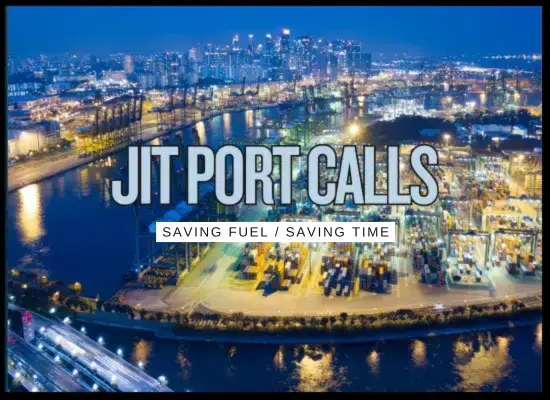
For many ships, “port time” really starts days before arrival, drifting in approach lanes and burning fuel while waiting for a berth. Just-in-Time (JIT) port calls flip that model: ports and ships share better ETA and berth-readiness data so the vessel can slow down and arrive when the pilot, berth and cargo team are actually ready. The prize is lower fuel burn and emissions, fewer hours at anchor, and a more predictable port stay, but it only works when everyone from terminals to charterers is willing to share information and adjust long-standing habits.
⏱️
What is it and Keep it Simple...
Just-in-Time (JIT) port calls mean the ship adjusts speed so it reaches the pilot boarding place
and berth when the port is actually ready, instead of racing in and waiting at anchor. Port actors
(terminal, pilotage, VTS, tugs, agents) share a reliable “requested time of arrival”, and the ship’s team
– or voyage optimisation tools – shape the speed profile around that time.
In practice, JIT is not magic software. It is a combination of better data (clean ETA/berth readiness
times), simple digital tools to push updates to ships, and commercial agreements that allow
slower steaming when everyone knows the berth will not be free earlier anyway. The target is less time “burning
fuel in the queue” and more time at efficient, predictable speeds.
On the technical side
Port call platforms, PCS systems and voyage tools exchange timestamps for berth readiness, pilot boarding,
cargo operations and departure. These are turned into a requested time of arrival that the vessel’s
navigation and operations teams can actually sail to.
For owners it means…
Fewer hours drifting or at anchor, lower fuel and carbon costs, and better schedule reliability – as long
as ports, terminals and charterers are willing to share plans early and stick to them when conditions allow.
Just-in-Time Port Calls: Advantages and Disadvantages
Category
Advantages
Disadvantages
Notes / Considerations
Fuel, emissions & speed
✅ Reduces unnecessary high-speed steaming followed by long waiting times, cutting fuel use and CO₂ for the same voyage.
✅ Studies and pilots show potential voyage-level fuel and GHG reductions in the high single digits to >20% when waiting time is significant.
✅ Supports CII, ETS and FuelEU Maritime exposure by turning “waiting at anchor” into “slower, optimised transit”.
❌ Savings depend heavily on trade, port congestion and how much advance notice of berth readiness is available.
❌ Weather, congestion and last-minute cargo changes can erode the theoretical benefit if plans shift late.
❌ Not every ship can freely adjust speed because of convoy, canal or slot constraints on the route.
Start with trades where ships routinely wait hours or days at anchor; use real AIS and fuel data to quantify the current “waste”.
Port & terminal operations
✅ Allows terminals and pilots to smooth peaks, reducing yard and waterside congestion.
✅ Better alignment of tug, pilot and berth schedules improves utilisation of port resources.
✅ Ports can market themselves as “JIT-ready”, supporting green corridor and digital-port strategies.
❌ Requires reliable, standardised timestamps and processes across terminals and service providers.
❌ Terminals may be reluctant to share realistic berth readiness times if internal planning is weak.
❌ Legacy systems and manual processes limit how often accurate updates can be sent to ships.
Many ports are using “digital port call” or PCS upgrades as the backbone for JIT; align with those roadmaps rather than creating a separate project.
Data, integration & standards
✅ Builds on emerging IMO and industry reference data models for port calls, making it easier to exchange ETAs, RTAs and service windows.
✅ Modern cloud platforms can replace phone/email chains with live shared timelines for all actors.
✅ Integration with voyage optimisation tools closes the loop between port readiness and ship speed.
❌ Data definitions (ETA, RTA, berth ready, pilot boarding) still vary between ports and actors.
❌ Integration with existing PCS, TOS, VTS and fleet systems can be slow and expensive.
❌ Poor data quality or late updates undermine trust and make crews hesitant to slow down.
Treat data quality as a core workstream: clear definitions, ownership and monitoring of key port call timestamps.
Contracts & commercial
✅ When charter parties, service contracts and port agreements are aligned, JIT can reduce bunker bills and emissions without harming schedule integrity.
✅ Transparent sharing of JIT gains can unlock cooperative schemes between owners, charterers and cargo interests.
❌ Traditional “utmost despatch” clauses can discourage slower steaming even when the berth will not be ready sooner.
❌ Unclear allocation of fuel and carbon savings (and risks) can stall uptake.
❌ Some counterparties may view speed reductions as a service degradation rather than an efficiency measure.
Review standard charter clauses and consider JIT-friendly wording, especially on trades where anchor waiting is chronic.
Safety & risk
✅ Less congestion at anchorages and port approaches can lower collision, grounding and pollution risk.
✅ More predictable pilot boarding times reduce pressure on pilots and tugs rushing between delayed ships.
❌ Over-optimistic JIT plans that leave no buffer can create pressure to maintain schedule in marginal weather or traffic conditions.
❌ Misaligned updates can cause ships to arrive under- or over-speed if information comes too late.
Keep a safety buffer in JIT timing assumptions and make clear that navigational safety always overrides “on-the-minute” arrivals.
Governance & adoption
✅ Fits directly into decarbonisation and digitalisation programmes, often with relatively quick wins versus new hardware investments.
✅ Pilots on specific corridors or trades allow owners and ports to build evidence and refine playbooks before scaling.
❌ Requires cross-functional governance: operations, chartering, IT, ports and HSSEQ all have a stake.
❌ Benefits can be hard to track if fuel, waiting time and schedule impacts are not measured before and after.
❌ Without clear leadership, JIT can get stuck as a “nice concept” in slide decks.
Nominate a JIT owner on both ship and shore sides; track a small set of KPIs (waiting time, fuel per voyage, CII impact) for each pilot trade.
Summary: Just-in-Time port calls are a practical way to turn port-related waiting time into lower speeds, lower fuel
burn and cleaner port approaches. The heavy lifting is not the algorithm but the coordination: aligning port data, contracts
and day-to-day decisions so that crews feel safe slowing down and everyone shares in the value of arriving “right on time”
instead of “as fast as possible, then waiting in line”.
🚢
2025–2026 Just-in-Time Port Calls: Is It Really Working?
What operators and ports are actually seeing once JIT moves from pilot slide to everyday port calls.
1 · Waiting time is really falling
On trades where ports and owners are aligned, pilots report fewer ships stacking up at anchor and more vessels
arriving close to a requested time of arrival instead of several hours early "just in case".
2 · Fuel and GHG savings are measurable
Projects that track AIS, speed and bunkers see lower average speeds on approach legs and fewer hours idling near port.
That shows up as several percent lower fuel per voyage on congested corridors, plus cleaner CII profiles.
3 · Port side is the main bottleneck
The biggest friction points are onshore: inconsistent timestamps, terminal reluctance to share realistic berth readiness,
and legacy systems that still depend on phones and email chains instead of structured updates.
4 · Commercial rules need to catch up
Where charter parties reward utmost despatch but ignore time at anchor, masters are understandably cautious about slowing
down. Successful JIT pilots usually include some charter or service clause tweaks, not only software.
5 · Crews like clear, stable RTAs
When requested times of arrival are credible and updated early, bridge teams find it easier to shape speed profiles
and avoid last minute engine orders. If RTAs move constantly at short notice, JIT loses trust quickly.
6 · Where it fits today
JIT works best on repeat trades and green corridors with digitally mature ports and motivated charterers. It is still hard
to scale across one off ports that lack digital port call tools or shared incentives to reduce waiting time.
Owner takeaway: treat JIT as a corridor project rather than a fleet wide switch. Pick a congested trade, work
with a few ports and charterers, and prove the fuel and waiting time savings there before you try to roll it out everywhere.
Just-in-Time Port Calls — Fuel, Time and Carbon Savings
Training values only - replace with your own trade data
Baseline Port Waiting and Sea Profile (Per Vessel)
Effect of JIT and Project Costs
Fuel and CO2 burned today (waiting plus sea) on JIT trades
—
Annual fuel reduction from JIT
—
Annual CO2 reduction from JIT
—
Net annual benefit after JIT costs
—
Payback, NPV and IRR over analysis period
—
This calculator is a simplified view of the impact of Just-in-Time port calls on one vessel. It estimates savings
from reduced waiting time at anchor and slower steaming into port, then subtracts JIT related platform and coordination
costs. Replace all values with your own AIS, bunker and port call data, and align assumptions with charter parties,
port rules and digital platform offers before using the results in any real investment cases.
For most owners, the real test for Just-in-Time is simple: does the combination of slower steaming and reduced waiting time save more in fuel and carbon cost than it adds in digital fees and coordination effort, without hurting schedule reliability. If you plug a few high-congestion trades into the calculator using your own AIS and bunker numbers, you will quickly see which corridors already support a JIT business case and where you still need stronger port data, charter alignment or digital infrastructure before the concept really pays off.