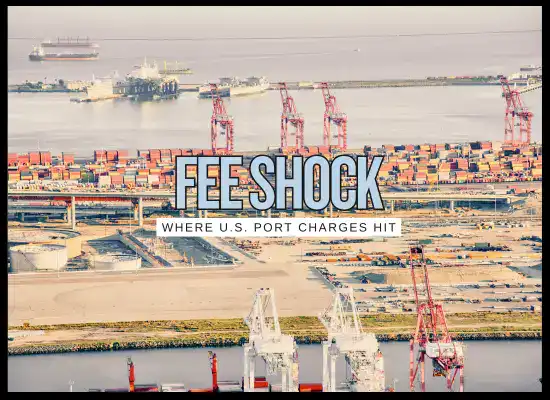
The clock is ticking for shipowners trading into the United States. Beginning October 14, 2025, Washington will impose steep new port fees on vessels that are either Chinese-owned/operated or built in Chinese shipyards. The move marks one of the most significant policy shifts in decades for global shipping, with direct cost implications that can run into the millions of dollars per voyage.
Unlike tariffs on cargo, these fees strike directly at the vessel level, hitting operators where it hurts: at the bottom line. A Very Large Crude Carrier (VLCC) built in China, for example, could face more than $5 million in additional costs for a single U.S. entry. Container lines, tanker operators, and bulk carriers alike are now recalculating routes, redeploying assets, and in some cases, rethinking their long-term fleet strategies.
But not all U.S. ports will feel the pressure equally. Because the fee applies only at the first U.S. port of call per rotation, certain gateways, those that serve as primary entry points for transpacific containers, Gulf Coast crude exports, and East Coast trade lanes will shoulder a disproportionate share of the impact.
This report identifies the 12 U.S. ports most exposed under the new rule, explaining how the costs stack up, and what shipowners need to know as they prepare for a more expensive American port call environment.
#1
Los Angeles / Long Beach — Primary Transpacific Gateway
West CoastFirst U.S. Port Trigger Risk: Very HighTrade: Asia ↔ U.S. Containers
Fee trigger
First U.S. port per rotation
Applies if LA/LB is first inbound U.S. call
High-exposure vessel types
Post-Panamax & Neo-Panamax boxships
High share of Chinese-built tonnage on TPX strings
Primary cost driver
$ / Net Ton or $ / Container
Rule chooses the higher applicable schedule
Mitigation window
Pre-effective rotations
Adjust loops, first-call ports, or fleet assignment
▶ Exposure snapshot What owners need to know
Why LA/LB is highly exposed
Frequent first-in U.S. entry for Asia services; triggers fee on arrival.
Container fleets on these strings include many Chinese-built hulls.
Volume concentration increases the odds your rotation touches LA/LB first.
When exposure is lower
Rotation enters via Canada/Mexico first (then rail/truck into U.S.).
Fleet assignment uses non-Chinese-built tonnage for first-call strings.
LA/LB is a subsequent U.S. call, not the first on the rotation.
▶ Cost scenarios Illustrative math
Illustrative examples to show the mechanism. Replace with your vessel’s actual net tonnage, container count, and rotation plan.
Scenario
Vessel profile
Fee basis
Illustrative inputs
Indicative exposure
Chinese-built container ship, LA/LB as first U.S. port
Neo-Panamax, 13k TEU
Higher of $/NT or $/container (rule-year schedule)
Assume 60,000 NT; 9,000 loaded boxes inbound
If container basis dominates:
9,000 × [$ per container for the rule year]
Else: 60,000 × [$ per NT for the rule year]
Non-Chinese-built and non-Chinese-owned container ship
Panamax, 5k TEU
Not in scope
—
Fee not triggered (still confirm first-call status)
Note: The fee applies once per U.S. rotation (first port only) and is subject to caps/phase-ins by year. Always confirm the current schedule before estimating exposure.
▶ Routing and commercial tactics Playbook
First-call strategies
Re-sequence rotation to shift first U.S. call away from LA/LB if feasible.
Use Canadian or Mexican gateways as the first North American call.
Assign non-exposed hulls to strings where LA/LB must be first call.
Commercial levers
Renegotiate slot/voyage terms to reflect fee risk on first-call strings.
Consider peak-season surcharges tied to fee applicability by vessel.
Model door-to-door cost with rail from Canada/Mexico vs. direct LA/LB discharge.
▶ Operational notes What the master/agent should prep
Documentation readiness
Clear evidence of build yard, ownership, and operator to confirm scope.
Compute both bases using current schedule; apply the higher
Chinese-owned/operated ship (non-Chinese build)
Post-Panamax, ~8k TEU
$/NT (ownership/operation schedule)
Assume 45,000 NT
45,000 × [$/NT for the rule year]
Non-Chinese-owned/operated and non-Chinese-built ship
Panamax, ~5k TEU
Out of scope
—
No fee (still verify first-call status and exemptions)
Note: Fee applies once per U.S. rotation (first port only) and is subject to phase-in by year and specific exemptions. Always check the current USTR schedule.
▶ Routing & commercial tactics Playbook
First-call strategies
Re-sequence loop to a different first U.S. gateway when operationally feasible.
Use Canadian/Mexican gateways first, then rail/truck into the U.S. as needed.
Assign non-exposed hulls to strings where Oakland must remain first-call.
Commercial levers
Reflect first-call fee risk in slot/voyage terms and surcharges.
Stress-test door rates: Oakland direct vs. Canadian/Mexican first-in + intermodal.
Monitor carrier announcements; some lines are already redeploying fleets around fee exposure.
▶ Operational notes What the master/agent should prep
Documentation readiness
Evidence of build yard/year; ownership and operator details.
Rotation plan confirming first U.S. port status for each voyage.
Agent briefed on applicable (current-year) fee schedule and any exemptions.
Berth & schedule control
Coordinate windows to avoid unintended first-call shifts mid-season.
Verify EDI/arrival sequence for compliance determination.
Track peak-season volume surges that may drive service adjustments.
▶ Data to track Owner’s worksheet
Field
Your value
Vessel name / IMO
Build yard / year
Ownership / operator
Net tonnage (NT)
Inbound loaded containers
Rotation first U.S. port
Oakland?
Rule-year fee schedule
Projected fee at Oakland
Quick checklist
Confirm if Oakland is the first U.S. call on your rotation.
Verify exposure status (Chinese-owned/operated vs. Chinese-built).
Calculate both fee bases ($/NT and $/container); apply the higher.
Model alternatives (gateway swap, intermodal) before the effective date.
Align contracts for fee pass-through where permissible.
#3
Seattle / Tacoma — Northwest Seaport Alliance
West CoastFirst U.S. Port Trigger Risk: HighTrade: Asia ↔ U.S. Containers & Bulk
Fee trigger
First U.S. port per rotation
Common first entry for North Asia services
High-exposure vessel types
Large boxships, car carriers, bulkers
Many fleets include Chinese-built hulls
Primary cost basis
$ / Net Ton or $ / Container
Apply the higher schedule for Annex II; $/NT for Annex I
Commercial importance
Gateway to Midwest
Rail intermodal connectivity magnifies impact
▶ Exposure snapshot What owners need to know
Why Seattle/Tacoma is significant
It serves as the **first U.S. port of call** for many transpacific services, especially from North Asia (China, Korea, Japan).
The port complex handles not just containers, but also car carriers and bulk trades—several categories likely to include Chinese-built vessels.
High reliance on intermodal rail means carriers can reroute via Canadian ports if fees distort economics, creating competition pressure.
When exposure is lower
If rotation enters the U.S. via California before calling Seattle/Tacoma.
If vessels deployed are outside scope (not Chinese-owned/operated, not Chinese-built).
When Canadian first-call alternatives (Vancouver, Prince Rupert) absorb the transpacific entry before shifting cargo to rail into the U.S.
▶ Cost scenarios Illustrative math
Examples to illustrate mechanics. Use actual vessel NT, container count, and rotation plan.
Scenario
Vessel profile
Fee basis
Illustrative inputs
Indicative exposure
Chinese-built container ship, Seattle first U.S. call
Neo-Panamax, ~14k TEU
Higher of $/NT or $/container (Annex II)
65,000 NT; 10,000 loaded boxes inbound
Compute both bases using current-year rates; apply higher
Chinese-owned/operated car carrier
PCTC, ~7k CEU
$/NT (Annex I)
30,000 NT
30,000 × [$/NT schedule for rule year]
Non-Chinese bulk carrier
Panamax bulker
Out of scope
—
No fee (still confirm first-call)
Note: Fee applies once per U.S. rotation (first port only). Annex I and II rates escalate annually through 2028. Check for exemptions (e.g., ballast arrivals).
▶ Routing & commercial tactics Playbook
First-call strategies
Evaluate Vancouver/Prince Rupert first-in to bypass fee, then rail south.
Shift first-call to California ports where strings already call before heading north.
Assign compliant hulls (non-exposed) to high-volume Asia–Seattle services.
Commercial levers
Incorporate fee exposure into slot pricing on first-call Seattle/Tacoma services.
Benchmark cost of Canadian entry + inland vs. direct Seattle call.
Adjust contracts/charters to reflect fee pass-through where feasible.
▶ Operational notes What the master/agent should prep
Documentation readiness
Proof of build yard, year, ownership, and operator.
Rotation plan confirming Seattle/Tacoma as first U.S. port.
Agent briefed on Annex I vs Annex II applicability.
Berth & scheduling
Coordinate arrival sequence to ensure fee determination is accurate.
Prepare for possible last-minute re-routing by carriers aiming to avoid fees.
Check any applicable exemptions (e.g., ballast arrivals, U.S.-built orders that qualify for relief).
▶ Data to track Owner’s worksheet
Field
Your value
Vessel name / IMO
Build yard / year
Ownership / operator
Net tonnage (NT)
Inbound loaded containers / CEU
Rotation first U.S. port
Seattle/Tacoma?
Rule-year fee schedule
Projected fee at Seattle/Tacoma
Quick checklist
Confirm Seattle/Tacoma as first U.S. call on the loop.
Verify whether vessel falls under Annex I or II.
Calculate both fee bases where applicable.
Consider Canadian alternatives; model inland cost vs. fee exposure.
Align contracts for fee pass-through before Oct 2025 effective date.
#4
Houston — Gulf Energy Hub (Tankers & Chemicals)
Gulf CoastFirst U.S. Port Trigger Risk: High (service-dependent)Trade: Crude/products/chemicals + containers
Fee trigger
First U.S. port per rotation
Applies if Houston is the first inbound U.S. call
High-exposure vessel types
Aframax/Suezmax, MR/LR product, chem tankers
Exposure depends on build/ownership of assigned hulls
Primary cost basis
$ / Net Ton (Annex I) or higher of $/NT vs $/container (Annex II)
Use current-year schedule; apply the higher where Annex II
Commercial sensitivity
Energy & chemical corridors
Dense call patterns amplify first-call exposure
▶ Exposure snapshot What owners need to know
Why Houston matters for the rule
It is a primary Gulf entry for tankers and chemical carriers trading to/from Latin America, Europe and beyond.
Where Houston is the first U.S. port after a foreign port, the fee can apply to exposed vessels.
Heavy concentration of product and chemical tanker calls means owners should verify each rotation’s first-call status.
When exposure is lower
Rotation enters via another U.S. Gulf port before Houston.
Assigned vessel is neither Chinese-owned/operated nor Chinese-built.
Houston is a subsequent call on the U.S. leg rather than first entry.
▶ Cost scenarios Illustrative math
Examples to illustrate mechanics. Replace with your vessel’s NT and rotation plan. (For containers, compute both bases under Annex II.)
Scenario
Vessel profile
Fee basis
Illustrative inputs
Indicative exposure
Chinese-owned/operated product tanker, Houston first U.S. call
MR/LR tanker
$/NT (Annex I)
Assume 25,000–30,000 NT
NT × [$/NT for the rule year]
Chinese-built Aframax, Houston first U.S. call
Aframax (clean/dirty)
Annex II: higher of $/NT or $/container
Assume ~40,000–50,000 NT
Compare both bases; apply higher per schedule
Non-exposed chemical tanker
IMO II/III
Out of scope
—
No fee (still confirm first-call sequencing)
Note: Fee applies once per U.S. rotation (first port only) and phases by year. Confirm current schedules and any applicable exemptions in force for the vessel/rotation.
▶ Routing & commercial tactics Playbook
First-call strategies
Re-sequence Gulf calls so another U.S. port is first entry when feasible.
Assign non-exposed hulls to rotations that require Houston as first-in.
For liner services with containers, evaluate alternatives where Annex II container basis would dominate.
Commercial levers
Reflect potential fee exposure in voyage T&Cs and charter clauses where permissible.
Model delivered-to-refinery/plant cost with alternate first-call sequencing.
Track carrier/operator advisories for any redeployments around fee exposure.
▶ Operational notes What the master/agent should prep
Documentation readiness
Proof of build yard/year; ownership and operator declarations.
Rotation plan confirming whether Houston is first U.S. entry.
Agent briefed on the applicable Annex/schedule for the voyage year.
Schedule control
Coordinate arrival sequence and EDI milestones used for compliance checks.
Ensure berth planning doesn’t unintentionally make Houston the first-in call.
Confirm any exemptions that may apply (e.g., as published for the current year).
▶ Data to track Owner’s worksheet
Field
Your value
Vessel name / IMO
Build yard / year
Ownership / operator
Net tonnage (NT)
Cargo type (crude/products/chem)
Rotation first U.S. port
Houston?
Rule-year fee schedule
Projected fee at Houston
Quick checklist
Confirm whether Houston is first U.S. call on the rotation.
Verify Annex applicability (ownership/operation vs. build).
Calculate exposure using the current-year schedule.
Evaluate alternative first-call sequencing in the Gulf.
Align contracts for pass-through before the effective date.
#5
Corpus Christi — Largest U.S. Crude Export Gateway
Gulf CoastFirst U.S. Port Trigger Risk: High (ballast arrivals to load)Trade: Crude oil & products export hub
Fee trigger
First U.S. port per rotation
Applies when a foreign-arriving vessel enters the U.S. at Corpus
High-exposure vessel types
Aframax/Suezmax; occasional VLCC involvement via Gulf
Exposure depends on build/ownership of the deployed hull
Primary cost basis
$ / Net Ton (Annex I) or higher of $/NT vs $/container (Annex II)
Use current-year schedule; apply higher where Annex II
It is the largest U.S. energy export gateway, handling substantial crude volumes.
Tankers frequently arrive from foreign waters to load; if **Corpus is the first U.S. entry**, exposed vessels can trigger the fee.
Recent channel deepening to 54 ft improves large-tanker efficiency, increasing the likelihood of high-NT vessels on call.
When exposure is lower
Rotation enters another U.S. port before Corpus Christi.
Assigned vessel is not Chinese-owned/operated and not Chinese-built.
An applicable exemption applies per the current USTR framework (verify annually).
▶ Cost scenarios Illustrative math
Use your vessel’s NT and rotation plan. For containers on liner calls, compute both bases under Annex II.
Scenario
Vessel profile
Fee basis
Illustrative inputs
Indicative exposure
Chinese-owned/operated product tanker, Corpus first U.S. entry
MR/LR tanker
Annex I: $/NT
25,000–30,000 NT
NT × [$/NT for the rule year]
Chinese-built Suezmax arriving to load
Suezmax crude
Annex II: higher of $/NT or $/container
~40,000–50,000 NT
Compute both bases per schedule; apply higher
Non-exposed tanker
Aframax/Suezmax
Out of scope
—
No fee (confirm first-call and any exemptions)
Note: Fee applies once per U.S. rotation (first port only) and phases by year under Annex I/II. Confirm current rates and any published exemptions before estimating exposure.
▶ Routing & commercial tactics Playbook
First-call strategies
Sequence Gulf calls so another U.S. port is first entry where operationally feasible.
Assign non-exposed hulls to rotations that must first-in at Corpus Christi.
For liner services, benchmark whether Annex II container basis would dominate vs. $/NT.
Commercial levers
Reflect potential fee in voyage/charter clauses where permissible.
Model delivered-to-terminal cost with alternative first-call sequencing.
Monitor operator announcements for redeployments tied to fee exposure.
▶ Operational notes What the master/agent should prep
Documentation readiness
Proof of build yard/year, ownership, and operator.
Rotation plan confirming whether Corpus is first U.S. port.
Agent briefed on Annex applicability and the current-year schedule.
Berth & schedule control
Coordinate arrival sequence and EDI milestones used for fee determination.
Avoid unplanned sequencing that inadvertently makes Corpus the first-in call.
Check any published exemptions/relief that could apply to the voyage.
▶ Data to track Owner’s worksheet
Field
Your value
Vessel name / IMO
Build yard / year
Ownership / operator
Net tonnage (NT)
Cargo (crude/products)
Rotation first U.S. port
Corpus Christi?
Rule-year fee schedule
Projected fee at Corpus
Quick checklist
Confirm if Corpus is the first U.S. call on your rotation.
Verify Annex I vs. Annex II exposure (ownership/operation vs. build).
Calculate exposure using the current-year rates.
Evaluate alternative first-call sequencing in the Gulf.
Align contracts for pass-through before the effective date.
#6
Port Arthur / Beaumont — Refining & Petroleum Hub
Gulf CoastFirst U.S. Port Trigger Risk: High (energy tankers)Trade: Crude & refined product exports
Fee trigger
First U.S. port per rotation
Applies if a foreign-arriving tanker enters via Port Arthur/Beaumont
High-exposure vessel types
VLCCs, Suezmax, Aframax tankers
Frequent energy trades; many hulls Chinese-built
Primary cost basis
$/NT (Annex I) or higher of $/NT vs $/container (Annex II)
Apply relevant schedule based on vessel status
Commercial importance
U.S. refining cluster
High outbound energy cargo concentration
▶ Exposure snapshot What owners need to know
Why Port Arthur/Beaumont is relevant
It is home to some of the largest U.S. refineries, exporting crude and refined products globally.
Tanker arrivals from abroad to load or discharge may trigger fees if this is the first U.S. port on rotation.
High proportion of large tankers (VLCCs, Suezmax) increases potential exposure under Annex I/II schedules.
When exposure is lower
Rotation enters via another Gulf or East Coast port before Port Arthur/Beaumont.
Vessels not falling under Annex I or II scope (not Chinese-owned/operated, not Chinese-built).
Ballast exemptions or relief conditions may apply; verify current USTR guidance.
▶ Cost scenarios Illustrative math
Examples for illustration. Replace with your vessel’s NT and voyage plan.
Scenario
Vessel profile
Fee basis
Illustrative inputs
Indicative exposure
Chinese-owned/operated Aframax, Port Arthur first-in
Aframax tanker
Annex I: $/NT
~30,000 NT
NT × [$/NT schedule for rule year]
Chinese-built VLCC, first U.S. entry at Port Arthur
VLCC ~300k DWT
Annex II: higher of $/NT or $/container
~160,000 NT
Compare both bases; apply higher
Non-exposed tanker
Suezmax
Out of scope
—
No fee (confirm sequencing & exemptions)
Note: Applies once per U.S. rotation (first port only). VLCCs and Suezmaxes represent high-cost exposure; check the current year Annex schedule.
▶ Routing & commercial tactics Playbook
First-call strategies
Sequence rotations so another Gulf port (e.g., Houston) is first-in when possible.
Assign non-exposed hulls to voyages requiring Port Arthur as first U.S. entry.
Monitor exemptions (e.g., ballast arrivals, U.S.-build orders qualifying for relief).
Commercial levers
Reflect exposure in freight/charter clauses when Annex applies.
Benchmark cost vs. rerouting through alternative Gulf entry points.
Stay alert for carrier/operator redeployments linked to fee avoidance.
▶ Operational notes What the master/agent should prep
Documentation readiness
Provide evidence of vessel build yard/year, ownership, and operator.
Rotation schedule showing Port Arthur/Beaumont as first-in if applicable.
Agent aware of which Annex applies and current-year fee rates.
Schedule & berth control
Confirm arrival sequencing in Gulf ports; avoid unplanned first-in status.
Align EDI and documentation with compliance checks.
Verify if relief provisions are available for the voyage year.
▶ Data to track Owner’s worksheet
Field
Your value
Vessel name / IMO
Build yard / year
Ownership / operator
Net tonnage (NT)
Cargo (crude/products)
Rotation first U.S. port
Port Arthur/Beaumont?
Rule-year fee schedule
Projected fee at Port Arthur/Beaumont
Quick checklist
Confirm if Port Arthur/Beaumont is the first U.S. call.
Verify vessel Annex classification (ownership/operation vs build).
Calculate exposure using current-year rates.
Explore Gulf sequencing options for fee mitigation.
Update contracts to allow fee pass-through when feasible.
#7
New York / New Jersey — Primary East Coast Container Gateway
East CoastFirst U.S. Port Trigger Risk: High (service-dependent)Trade: Transatlantic and all-water Asia services
Fee trigger
First U.S. port per rotation
Applies when NY/NJ is the first inbound U.S. call
High-exposure vessel types
Large container ships
Exposure depends on ownership/operation and build
Primary cost basis
$ / Net Ton (Annex I) or higher of $/NT vs $/container (Annex II)
Use the current-year schedule; apply the higher where Annex II
Commercial sensitivity
Gateway scale
High volume and frequent first-call patterns increase fee risk
▶ Exposure snapshot What owners need to know
Why NY/NJ is on the list
Major first U.S. entry for transatlantic services; also serves all-water Asia strings.
If the service designates NY/NJ as first-in, exposed vessels can trigger the fee at arrival.
High container volumes mean more rotations where first-call status matters.
When exposure is lower
Rotation enters via another U.S. port (or Canada) before NY/NJ.
Assigned vessel is outside scope (not Chinese-owned/operated and not Chinese-built).
NY/NJ is a subsequent call on the U.S. leg rather than first entry.
▶ Cost scenarios Illustrative math
Replace with your vessel’s NT, inbound boxes, and rotation plan. For Annex II, compute both bases.
Scenario
Vessel profile
Fee basis
Illustrative inputs
Indicative exposure
Chinese-built container ship, NY/NJ first U.S. call
Neo-Panamax, ~14k TEU
Annex II: higher of $/NT or $/container
~65,000 NT; 9,000–10,000 loaded boxes inbound
Compute both bases using current-year schedule; apply higher
No fee (still verify first-call status and exemptions)
Note: The fee applies once per U.S. rotation (first port only) and escalates by schedule year. Confirm current rates and any exemptions before estimating exposure.
▶ Routing and commercial tactics Playbook
First-call strategies
Re-sequence calls so another U.S. East Coast port is first entry where operationally feasible.
Use Canadian first-in gateways and move inland by rail if economics warrant.
Assign non-exposed hulls to services where NY/NJ must remain the first U.S. port.
Commercial levers
Reflect first-call fee risk in slot pricing and voyage terms where permissible.
Benchmark door rates: NY/NJ direct versus Canadian first-in plus intermodal.
Monitor carrier advisories for redeployments or loop changes affecting first-call status.
▶ Operational notes What the master/agent should prep
Documentation readiness
Proof of build yard/year; ownership and operator details.
Rotation plan confirming whether NY/NJ is first U.S. entry.
Agent briefed on Annex applicability and the current-year schedule.
Schedule control
Coordinate arrival sequence to avoid unintended first-in status changes.
Verify EDI events used in fee determination.
Check any published exemptions or relief provisions for the voyage year.
▶ Data to track Owner’s worksheet
Field
Your value
Vessel name / IMO
Build yard / year
Ownership / operator
Net tonnage (NT)
Inbound loaded containers
Rotation first U.S. port
New York/New Jersey?
Rule-year fee schedule
Projected fee at NY/NJ
Quick checklist
Confirm whether NY/NJ is the first U.S. call.
Verify Annex I vs Annex II exposure.
Calculate both fee bases where Annex II applies; use the higher.
Model Canadian first-in alternatives if cost-effective.
Align contracts for pass-through before the effective date.
#8
Savannah — Leading U.S. Southeast Container Port
East CoastFirst U.S. Port Trigger Risk: Moderate–HighTrade: Asia all-water, Latin America, Europe
Fee trigger
First U.S. port per rotation
Applies if Savannah is designated first U.S. call
High-exposure vessel types
Large container ships (Neo-Panamax)
Exposure varies by service deployment
Primary cost basis
$ / NT (Annex I) or higher of $/NT vs $/container (Annex II)
Use current-year schedule; apply higher if Annex II
Commercial importance
Fastest-growing U.S. container port
Volume scale increases fee sensitivity
▶ Exposure snapshot What owners need to know
Why Savannah is included
It is a top East Coast port for Asia all-water and transatlantic services.
When Savannah is first U.S. entry, Annex I or II fees may apply to exposed vessels.
Volume concentration makes Savannah an important exposure point for owners with East Coast loops.
When exposure is lower
If another East Coast port (e.g., NY/NJ or Norfolk) is first entry.
If deployed vessels are neither Chinese-owned/operated nor Chinese-built.
Where exemptions or relief apply under the current USTR schedule.
▶ Cost scenarios Illustrative math
Replace with actual NT and inbound containers for your rotation. Annex II requires comparing both fee bases.
East CoastFirst U.S. Port Trigger Risk: Service-dependentTrade: RoRo (autos/machinery), breakbulk, containers
Fee trigger
First U.S. port per rotation
Applies if Baltimore is designated the first inbound U.S. call
Higher-exposure vessel types
PCTC/RoRo car carriers; multipurpose; some boxships
Exposure depends on ownership/operation and build
Primary cost basis
$ / NT (Annex I) or higher of $/NT vs $/container (Annex II)
Use current-year schedule; apply higher where Annex II
Operational watchpoints
Channel & berth planning
Confirm sequencing; verify agent documentation early
▶ Exposure snapshot What owners need to know
Why Baltimore is on the list
One of the leading U.S. gateways for autos and RoRo machinery, plus significant breakbulk.
Where a PCTC or MPP service designates Baltimore as the first U.S. entry after a foreign port, exposed vessels can trigger the fee.
Containers via Seagirt add additional rotations where first-call status may matter, depending on service design.
When exposure is lower
Rotation enters via another U.S. East Coast port (e.g., NY/NJ, Norfolk) before Baltimore.
Deployed vessel is neither Chinese-owned/operated nor Chinese-built.
An applicable exemption/relief applies under the current USTR schedule (verify annually).
▶ Cost scenarios Illustrative math
Use your vessel’s net tonnage (NT), cargo profile, and actual rotation. For Annex II, compute both bases and apply the higher.
Scenario
Vessel profile
Fee basis
Illustrative inputs
Indicative exposure
PCTC (car carrier), Baltimore first U.S. call
~7,000 CEU
Annex I: $/NT if Chinese-owned/operated; Annex II if Chinese-built
~28,000–32,000 NT
Annex I: NT × [$/NT schedule]; Annex II: compare $/NT to container basis (if applicable)
Multipurpose/heavy-lift, first-in at Baltimore
MPP
Annex I or II depending on exposure
~15,000–25,000 NT
Calculate per current-year schedule
Container ship calling Seagirt, first-in
Post/Neo-Panamax
Annex II: higher of $/NT or $/container (if Chinese-built)
~45,000–65,000 NT; inbound boxes per service plan
Compute both bases; apply higher
Non-exposed vessel
Any class
Out of scope
—
No fee (still verify first-call sequencing and exemptions)
Note: Fee applies once per U.S. rotation (first port only) and escalates by schedule year. Confirm current rates and any exemptions before estimating exposure.
▶ Routing and commercial tactics Playbook
First-call strategies
Design rotations so another East Coast port is first-in when feasible.
Assign non-exposed hulls (by ownership/operation or build) to services that must first-in at Baltimore.
For container strings, compare Annex II container basis vs. NT and consider gateway swaps if economics warrant.
Commercial levers
Reflect first-call fee exposure in voyage/slot terms where permissible.
Benchmark door-to-door costs against alternative first-in sequencing (e.g., NY/NJ or Norfolk first).
Watch carrier/operator advisories for rotation changes affecting first-call status.
▶ Operational notes What the master/agent should prep
Documentation readiness
Proof of build yard/year; ownership and operator details.
Rotation plan confirming whether Baltimore is the first U.S. port.
Agent briefed on Annex applicability and current-year schedule.
Schedule management
Verify arrival sequencing to avoid unintended first-in status.
Ensure EDI events accurately reflect first-call determination.
Check published exemptions/relief each year and apply where eligible.
▶ Data to track Owner’s worksheet
Field
Your value
Vessel name / IMO
Build yard / year
Ownership / operator
Net tonnage (NT)
Cargo type (autos/MPP/containers)
Rotation first U.S. port
Baltimore?
Rule-year fee schedule
Projected fee at Baltimore
Quick checklist
Confirm if Baltimore is the first U.S. call.
Verify Annex I (ownership/operation) or Annex II (build) status.
Calculate both bases where Annex II applies; use the higher.
Evaluate alternatives for first-in sequencing if exposure is material.
Address pass-through in contracts before the effective date.
#12
New Orleans — Lower Mississippi Gateway
Gulf CoastFirst U.S. Port Trigger Risk: ModerateTrade: Grain, bulk, breakbulk, containers
Fee trigger
First U.S. port per rotation
Applies if New Orleans is first inbound port on a foreign rotation
High-exposure vessel types
Bulk carriers, RoRo, some container ships
Exposure varies by fleet mix and call patterns
Primary cost basis
$ / NT (Annex I) or higher of $/NT vs $/container (Annex II)
Check vessel classification and schedule year
Commercial importance
Key Mississippi River port
Handles major U.S. grain exports and diverse cargoes
▶ Exposure snapshot What owners need to know
Why New Orleans matters
Gateway for U.S. grain and bulk exports moving downriver to foreign markets.
Handles a mix of breakbulk, RoRo, and containerized trades.
When designated as the first U.S. entry, exposed vessels under Annex I or II may trigger the fee.
When exposure is lower
Another Gulf port (e.g., Houston, Corpus Christi) precedes New Orleans in the rotation.
Deployed vessel not Chinese-owned/operated and not Chinese-built.
Ballast or exemption status applies under the USTR schedule.
▶ Cost scenarios Illustrative math
Examples only; replace with vessel NT, cargo profile, and rotation details.
Scenario
Vessel profile
Fee basis
Illustrative inputs
Indicative exposure
Chinese-owned bulk carrier, first-in New Orleans
Panamax bulker
Annex I: $/NT
~25,000–30,000 NT
NT × [$/NT rule-year rate]
Chinese-built container ship, New Orleans first-in
Mid-size ~6–8k TEU
Annex II: higher of $/NT or $/container
~35,000–45,000 NT; 4–6k inbound boxes
Compute both bases; apply higher
RoRo vessel first-in
PCTC car carrier
Annex I or II depending on exposure
~25,000–30,000 NT
Calculate per current-year schedule
Non-exposed vessel
Any class
Out of scope
—
No fee (still confirm sequencing and exemptions)
Note: Fee applies once per U.S. rotation (first port only). Verify current rates and exemptions under Annex I/II before estimating exposure.
▶ Routing and commercial tactics Playbook
First-call strategies
Sequence Gulf rotations so Houston or Corpus Christi is first-in when possible.
Deploy non-exposed hulls for rotations where New Orleans must be first-in.
Adjust export programs to minimize fee exposure on high-NT bulkers.
Commercial levers
Reflect fee exposure in charter party clauses where permissible.
Benchmark delivered-to-terminal economics with alternative first-in sequencing.
Track carrier/operator advisories on redeployments linked to fee avoidance.
▶ Operational notes What the master/agent should prep
Documentation readiness
Provide build yard/year, ownership, and operator documentation.
Rotation plan confirming if New Orleans is the first U.S. port.
Agent aware of Annex applicability and current-year schedule.
Schedule and berth management
Confirm arrival sequencing along the Mississippi to avoid unintended first-in designation.
Ensure EDI milestones align with compliance checks.
Review any exemptions or relief published by USTR each year.
▶ Data to track Owner’s worksheet
Field
Your value
Vessel name / IMO
Build yard / year
Ownership / operator
Net tonnage (NT)
Cargo type (grain/bulk/containers/RoRo)
Rotation first U.S. port
New Orleans?
Rule-year fee schedule
Projected fee at New Orleans
Quick checklist
Confirm if New Orleans is the first U.S. call.
Verify Annex I or Annex II classification.
Calculate exposure using NT and containers if Annex II applies.
Explore sequencing via Houston/Corpus Christi to reduce risk.
Ensure contract terms address pass-through before effective date.