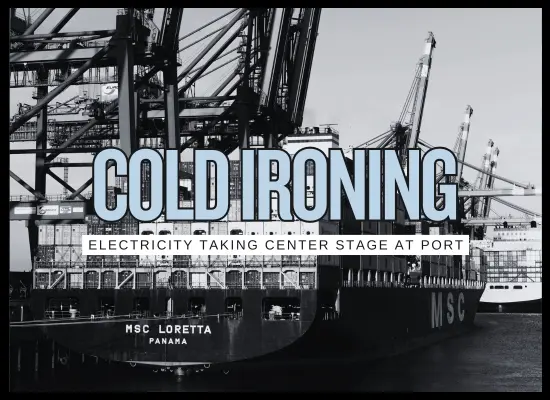
Cold ironing is the moment a ship “flips the switch” from its own engines to the pier. Instead of running auxiliary generators for days at berth, the vessel plugs into the port’s high-voltage grid and pulls clean electricity while engines sit idle. Going into 2026, that is no longer a nice-to-have: EU FuelEU Maritime rules will force large container and passenger ships to use onshore power at major EU ports from 2030, while California is already tightening at-berth rules to cover tankers and ro-ros from 2025 onward.
⚡
What is it and Keep it Simple...
Cold ironing (also called shore power or onshore power supply, OPS)
is when a ship shuts down its diesel generators in port and plugs into the local electricity grid instead.
Cables from the quay connect to a high-voltage substation on board; once synchronised, the ship’s hotel and
cargo systems run on shore electricity while the engines stay off.
Think of it as “turn off the ship, turn on the plug”. For the community, that means a large cut
in NOx, SOx, particulates and noise around the port. For the owner, it is a way to avoid burning expensive
fuel while at berth and to meet tightening at-berth emission rules — provided the grid power is available,
stable and priced sensibly.
On the technical side
Ports install transformers, frequency converters and high-voltage outlets on the quay. Ships that are
“shore-power ready” have compatible switchboards, safety interlocks and cable management gear. Once
connected, auxiliary engines are shut down and all hotel loads run on shore electricity.
For owners it means…
Lower fuel burn and stack emissions in port, easier compliance with California and EU at-berth rules, and
a better story for ports and local communities — but also capex for ship and port upgrades, new operating
procedures and exposure to grid pricing and availability.
Cold Ironing (Shore Power): Advantages and Disadvantages
Category
Advantages
Disadvantages
Notes / Considerations
Emissions & noise
✅ Cuts local NOx, SOx and particulate emissions from auxiliary engines, improving air quality around port cities.
✅ Can reduce at-berth CO₂ emissions significantly where grid power is low-carbon (hydro, wind, solar, nuclear).
✅ Lower noise and vibration at the quay improve conditions for crews and nearby residents.
❌ Climate benefit depends on the grid mix: coal-heavy power can shift emissions upstream rather than remove them.
❌ If ships stay connected longer than needed, they still draw power and incur charges without any operational gain.
Check the port’s grid emissions factor and how it compares to your auxiliary engines burning VLSFO or MGO.
Compliance & regulation
✅ Helps satisfy California’s At-Berth Regulation, which now covers container, cruise, tanker and ro-ro segments on a phased timeline from 2025–2027.
✅ Supports EU FuelEU Maritime and AFIR requirements: from 2030, large container and passenger ships must use onshore power or an equivalent zero-emission solution at major EU ports. {index=1}
✅ OPS availability is increasingly a plus point in port environmental scorecards and green corridor initiatives.
❌ Different jurisdictions have different rules, monitoring and reporting requirements, adding paperwork and complexity.
❌ Non-compliance can mean fees or even detainment once rules tighten, especially in the EU and California.
Map current and future port calls against at-berth rules; prioritise retrofits for ships most exposed to OPS mandates.
Cost & business case
✅ Avoids burning marine fuel at berth; when grid power is reasonably priced, energy cost per kWh can be competitive.
✅ Can reduce maintenance on auxiliary engines and after-treatment systems by lowering hours run.
✅ Access to incentives or grants in some regions (e.g. EU funds, state programmes) can improve project economics.
❌ Significant capex: shipboard modifications plus port infrastructure, especially where voltage/frequency conversion is needed.
❌ Electricity tariffs, demand charges and connection fees can erode savings or even make OPS more expensive than fuel in some markets.
❌ Utilisation risk: if only a fraction of calls can use OPS (limited ports or berths), payback stretches.
Build route-specific models that include port electricity prices, expected OPS hours, fuel prices and any ETS / carbon costs.
Technical & grid integration
✅ Mature IEC standards exist for high-voltage shore connection; equipment is proven on cruise, container and ro-ro fleets.
✅ Automation and cable-management systems are improving, reducing connection time and manpower requirements.
✅ Grid operators can plan port loads and integrate OPS with local renewables and storage.
❌ Many ports still lack sufficient grid capacity, particularly where multiple large ships berth simultaneously.
❌ Retrofits on older ships can be complex, with limited space for transformers, switchgear and cable handling gear.
❌ Power quality issues or outages can disrupt operations if redundancy is not built in.
Early grid and layout studies with utilities are critical; consider phased deployment starting with one or two berths.
Deployment & timeline
✅ By 2025, around 60% of surveyed European ports offer some form of OPS, with half providing high-voltage connections, and the global shore-power market is growing at ~10% CAGR. {index=3}
✅ Major ports (e.g. Hamburg, LA/LB, several Scandinavian and northern European hubs) are actively expanding OPS ahead of 2030 deadlines.
✅ Several cruise and container lines have committed to using OPS whenever it is available.
❌ Studies show that, even in Europe, only about 20% of the OPS connections required for 2030 are installed or contracted; container berths lag cruise/passenger.
❌ Many second-tier ports and terminals have not yet started serious OPS projects, especially outside the EU and North America.
Assume patchy availability into the late 2020s; focus on key green corridors and high-call ports when planning investments.
Operations & culture
✅ Clear procedures and training make connection and disconnection routine, reducing risk and delay.
✅ Crews appreciate lower noise and vibration when engines are off; ports benefit from a quieter waterfront.
❌ Initial learning curve: engineers and electricians need time and drills to build confidence with high-voltage connections.
❌ Misaligned port/ship schedules can cause “missed connections” if OPS teams or equipment are not ready when the ship is.
Treat OPS like any other critical operation: checklists, drills, clear responsibilities between ship, terminal and utility.
Summary: Cold ironing is one of the few decarbonisation tools that delivers immediate, local air-quality and noise
benefits with proven technology. The challenge going into 2026 is not whether it works, but whether grids, ports, ships
and commercial structures can scale it fast enough and in the right places to meet California and EU mandates without
creating new bottlenecks on the quay or in the power system.
🧊
2025–2026 Cold Ironing: Is It Really Working?
How far onshore power has moved beyond pilots, and where it still struggles.
1 · Cruise and ferries: mainstream
Large cruise and ferry operators now treat shore power as standard at equipped berths in North America and Europe.
Connection times are down, procedures are routine, and some ports report thousands of OPS calls per year without
major technical issues.
2 · Containers: scaling, but uneven
Several big container hubs have high-voltage OPS in place or under construction, and lines are wiring newbuilds
for shore power. However, coverage is still patchy and often limited to specific terminals or berths in each port.
3 · Tankers, bulkers and ro-ros: early days
A few tanker, bulker and ro-ro projects are live or in late design, driven mainly by California and European
pilots. For many industrial ports the challenge is grid capacity and space for transformers rather than shipboard
technology.
4 · Grid and tariff friction
Where shore power works technically, the next hurdle is price: demand charges, taxes and peak-load tariffs can
make electricity more expensive than running auxiliaries, especially in coal-heavy grids or with volatile power
markets.
5 · Availability gap
Even optimistic studies show a large gap between the OPS capacity that exists today and what will be required by
2030 rules. Many ports have announced plans, but not all have funding, grid agreements and construction underway.
6 · Where it fits today
Cold ironing is already a solid, scalable tool for cruise, ferry and container fleets calling at equipped ports.
For other segments, it is best treated as a corridor-specific option: pick the ports and trade lanes where OPS is
real, then decide which ships justify a retrofit or OPS-ready newbuild.
Owner takeaway: the question is no longer “does shore power work?” but “on which routes will the
combination of rules, grid price and OPS availability make it pay back for my specific ships.”
Cold Ironing — Energy, CO₂ and Payback
Training values only — replace with your route and port data
Baseline At-Berth Energy Use (Per Vessel)
Fuel, Power, Carbon and Project Costs
Annual OPS-eligible hours and energy
—
Annual cost: fuel vs shore power + carbon
—
Annual CO₂ reduction from OPS
—
Net annual benefit after OPS running costs
—
Payback, NPV and IRR over analysis period
—
This calculator focuses on the portion of alongside time that could realistically switch from auxiliary fuel to shore
power. It compares fuel + carbon cost against grid + carbon + OPS fees and maintenance, then applies the shipboard
capex and a simple discounted cash flow model. Replace all values with your own port calls, load profiles, prices,
emission factors and vendor quotes before using it in any real decision-making.
Cold ironing is one of the few decarbonisation levers where the engineering is largely solved and the real questions are “where is the grid strong enough, what does the electricity cost, and how often can I actually plug in on my routes.” If you drop your own port calls, alongside hours, load profiles and local tariff / ETS assumptions into the calculator, you can quickly see whether shore power looks like a compliance cost, a genuine fuel and carbon saving, or a mix of both for each vessel or trade lane.