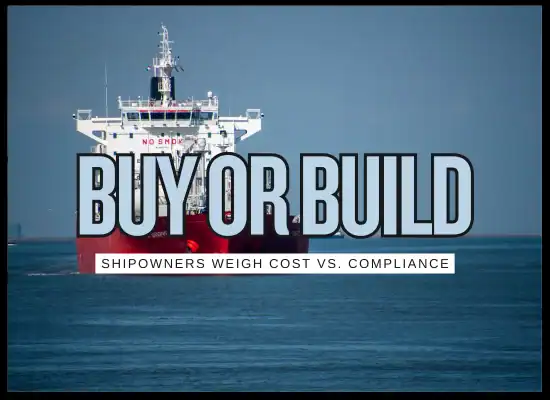
The maritime landscape sits at a pivotal crossroads. Used-ship prices are soaring, driven by intense demand from owners needing immediate tonnage and limited newbuild slots. Meanwhile, newbuilding costs remain at record highs, about $90 million on average, while shipyards are fully booked for the next several years.
This price lead-time squeeze is compounded by renewal pressures:
Environmental compliance, owners must pivot toward low- and dual-fuel vessels.
Rerouted journeys (e.g., around the Cape due to Red Sea risks) are boosting demand for tonnage right now.
Yet, newbuild delivery delays are stretching lead times to 18–36 months, especially for bulkers and tankers.
The result? Shipowners face a stark question: Do you buy used ships to deploy today, retrofit and hope for ROI or wait years and spend more for a brand-new, greener, and bespoke vessel? In this report, we’ll break it down.
Use our ShipUniverse Ship Financing & ROI Calculator to model your ship acquisition scenarios with real‑time analytics. Evaluate financing options, charter yields, and payback periods, all in one smart tool.
• Quick-mode and deep-dive options
• Tailored for different vessel types and markets
• Integrates financing, opex, and revenue assumptions
The secondhand ship market is holding strong. Despite earlier expectations of a post-pandemic slowdown, used vessel prices remain high. Bulk carriers, tankers built after 2010, and ships already fitted with compliance upgrades are especially in demand.
Several key developments are shaping this trend:
Many shipyards are fully booked through 2027, making used ships the only way to secure tonnage without delay.
Ongoing Red Sea disruptions are forcing longer routes, which increases demand for immediately available vessels.
Buyers are prioritizing ships with scrubbers, energy-saving devices, or existing methanol-ready infrastructure.
Investment funds and private equity firms are reentering the market to capitalize on strong charter rates.
Some owners are choosing to purchase younger used ships, retrofit them, and delay newbuild orders until fuel technology is more settled.
This strategy allows flexibility while avoiding long wait times and high costs tied to new construction. As a result, used tonnage continues to trade at historically firm levels.
🛳️ Recent Developments
Trend
Description
Market Impact
Surging Demand
Fleet owners need vessels immediately due to longer trade routes and port delays.
Prices remain elevated for vessels ready to deploy.
Delayed Newbuilds
Most major shipyards are booked out beyond 2026.
Used vessels are the only short-term option.
Scrubber-Equipped Sales
Ships with exhaust gas cleaning systems are trading at a premium.
Buyers see better fuel flexibility and charter prospects.
Retrofit-Ready Vessels
Newer used ships (post-2013) are being upgraded for longer use.
Owners are using retrofits to extend operational life.
Private Equity Return
Financial investors are targeting short-term ROI through asset-backed charters.
Fueling higher transaction volumes and resale competition.
Note: Data reflects activity through Q2 2025 and includes dry bulk, tanker, and multipurpose vessel trends.
✅ Used Ship Pros
Advantage
Benefit
Supporting Context (2025)
Immediate Availability
Can deploy within weeks — no waiting years for delivery.
Newbuilds face 18–36 month timelines.
Lower Upfront Cost
Acquisition cost remains well below newbuilds.
Used prices near record highs—but still cheaper than ~$90 m newbuilds.
Proven Performance
Trackable history reduces risk of unknown faults.
Due diligence can uncover fuel and maintenance reliability.
Retrofit Flexibility
Can be upgraded — scrubbers, digital tools, fuel systems.
Retrofitting avoids newbuild backlog; compliance-ready vessels are trading at premiums.
Immediate Cash Flow
Generates revenue almost immediately upon purchase.
Charter rates are elevated due to trade route disruptions and limited supply.
Note: Data compiled from market reports and industry consults.
❌ Used Ship Cons
Disadvantage
Explanation
2025 Context
Regulatory Risk
Older vessels may not comply with upcoming IMO/EU regulations.
IMO CII and EU ETS enforcement is tightening, especially for high-emission ships.
Shorter Operational Life
Vessels may only have 5–10 years of usable service left.
Depreciation accelerates after age 15–20 depending on vessel type.
Unforeseen Maintenance
Wear-and-tear can lead to higher than expected operating costs.
Engine overhauls, hull corrosion, and outdated electronics are common pain points.
Retrofit Costs
Upgrades needed for compliance or charterability can be expensive.
Scrubber installs, digital navigation, and ballast system retrofits can exceed $3–5 million.
Lower Financing Favorability
Used vessels may not qualify for ESG-linked loans or green finance instruments.
Lenders increasingly prefer newbuilds with lower carbon footprints and longer lifespans.
Note: Reflects risks identified in broker reports, technical audits, and financing reviews through mid-2025.
Newbuilds: Recent Developments / Pros / Cons
The used ship market continues to defy expectations. Instead of softening after the post-pandemic boom, prices for secondhand tonnage, especially bulk carriers and mid-aged tankers have held firm or even increased in some segments.
The key drivers behind this resilience are:
Long newbuild lead times (18–36 months), which make used vessels the only way to secure immediate capacity.
Red Sea rerouting and global supply chain shifts that increase spot-market demand.
Fuel compliance retrofitting—older ships that are scrubber-equipped or “methanol-ready” have become niche hot commodities.
Owners seeking ROI now rather than speculating on tech or fuel trends five years out.
Investment firms re-entering the market, betting on high day rates to cover the shorter remaining lifespan of older vessels.
Notably, some owners are pursuing a “bridge strategy”: acquiring relatively modern used vessels (built after 2013) and investing in retrofits to delay expensive newbuild orders until regulatory clarity (especially around fuels) improves.
🛳️ Newbuild Market Developments
Trend
Description
Market Impact
Green‑Fuel Integration
70% of new orders are LNG dual‑fuel; 14% are methanol‑ready.
Operators are future‑proofing, increasing shipyard demand for green builds.
Backlogged Shipyards
Major yards are fully booked through 2026–27.
Delivery lead times stretching to 2–3 years; immediate supply limited.
Q1 2025 Order Decline
Newbuild contracts halved vs. Q1 2024.
Market pausing due to economic and regulatory uncertainty.
Inflated Newbuild Costs
Prices highest in 16 years—up 53% since 2020, plus 6% more in early 2025.
Strains capex budgets; accelerates interest in used-retrofit alternatives.
U.S. SHIPS Act Push
Bill mandates quotas for US‑built, US‑flag vessels.
Domestic demand surge; further tightens global yard slots.
Note: Based on data from shipbroker, yard and regulatory sources.
✅ Newbuilds pros
Advantage
Benefit
2025 Context
Latest Fuel-Ready Design
Built for LNG, methanol, ammonia or hydrogen, ensuring compliance with upcoming IMO rules.
Over 30% of new orders include LNG dual-fuel; ~14% are methanol-ready.
Operational Efficiency
Optimized hull forms and energy systems lower OPEX and emissions.
New eco-tech yields ~15% energy savings or $2–5 M/year.
Longer Useful Life
Expect 25+ years of service with higher residual value.
Fleet aging (avg 12.7 years) driving orders for long-term replacements.
Enhanced Financing Options
Eligible for green loans, ESG bonds, and lower interest based on fuel choice.
Financiers favour vessels aligned with IMO decarbonization targets.
Tailored Specifications
Custom-built for specific routes, cargo types or performance criteria.
Note: Reflects industry performance projections and financing trends.
❌ Newbuild Cons
Disadvantage
Explanation
2025 Context
Long Delivery Times
Ships ordered today won’t be delivered for 18 to 36 months.
Most major yards are fully booked through 2026 and beyond.
High Upfront Cost
Newbuilds require significant capital and financing.
Newbuild prices have risen over 50% since 2020 and are still increasing.
Tech Obsolescence Risk
Fuel systems or emissions tech may become outdated during build time.
Uncertainty remains over long-term viability of LNG vs. methanol vs. ammonia.
Limited Flexibility
Once under construction, changes are difficult and costly.
Unexpected regulation changes or market shifts can leave owners locked in.
Opportunity Cost
Capital tied up in a non-earning asset during construction period.
Used vessels can generate earnings immediately; newbuilds sit idle until launch.
Note: Compiled from shipbuilding forecasts, yard orderbooks, and regulatory commentary.
Final Verdict: Used Ships vs. Newbuilds in 2025
The best choice between used ships and newbuilds depends on one core factor: your time horizon.
If your priority is earning revenue quickly, seizing current charter opportunities, or avoiding long delivery delays, used ships offer a faster path to ROI—especially when the vessel is young and can be upgraded cost-effectively.
If you're building for the next 15–20 years, planning to meet regulatory targets head-on, and securing ESG-aligned financing, newbuilds offer longer-term security, better fuel performance, and access to top-tier charters.
Most fleets are not fully choosing one over the other. Many are balancing their portfolio, acquiring used ships to serve today’s demand while placing newbuild orders for strategic growth and compliance readiness.
Verdict – Used Ships vs. Newbuilds
Factor
Used Ships
Newbuilds
Availability
Ready in weeks or months
Delivery in 18–36 months
Upfront Cost
Lower acquisition cost
Significantly higher capex
Regulatory Compliance
May require retrofitting
Built to meet 2030+ standards
Operational Lifespan
Shorter (often <10 years)
15–25 year horizon
Cash Flow Timing
Immediate charter income
Delayed revenue stream
Financing Appeal
Limited green loan options
Eligible for ESG-linked financing
Best Fit For
Short-term ROI, opportunistic trades
Long-term strategy, compliance, asset value
Note: Based on market conditions, financing trends, and regulatory developments.