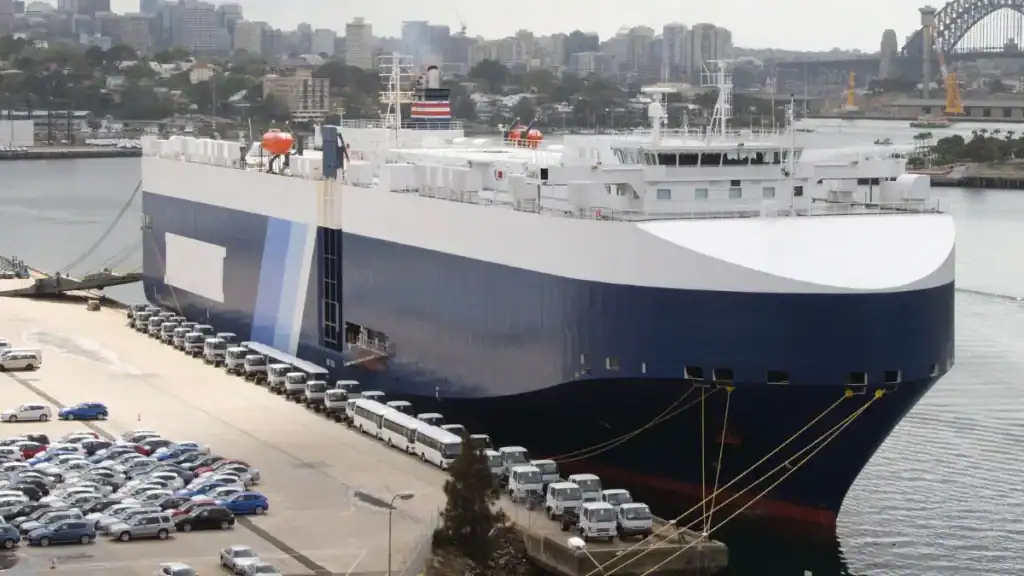
A spate of fires aboard vehicle carriers carrying electric vehicles (EVs) has spotlighted the rising dangers posed by lithium-ion batteries at sea. With each region-wide surge in EV exports, shipping industry leaders are racing to reassess safety protocols, compartment design, and fire response systems to prevent a repeat of recent incidents.
The Morning Midas, a Liberia-flagged roll-on/roll-off car carrier en route from Japan to Mexico, ignited on June 3, about 300 miles southwest of Adak Island, Alaska. The blaze began near a deck loaded with EVs and hybrids, and the ship sank on June 24 after battling relentless flames and heavy seas.
Brief Overview:
Smoke and fire initially confined to the EV deck despite conventional suppression systems
All 22 crew evacuated safely, monitored by nearby vessels and the U.S. Coast Guard
Salvage teams declared the fire extinguished on June 16, though damage proved fatal to the vessel
The sinking drew attention to how EV battery fires resist CO₂ suppression and may reignite
Fire Risk Factors on EV Carriers
Risk Factor
Description
EV-Specific Challenge
Mitigation Status
Thermal Runaway
Lithium-ion batteries can enter a self-heating cycle leading to uncontrollable fire.
Battery packs in EVs can ignite days after damage due to internal short circuits.
Partially addressed via battery design standards; full vessel-scale solutions still in development.
Lack of Ventilation
Car carrier decks are often poorly ventilated, allowing heat and smoke to build rapidly.
Toxic gases from EV battery fires can build up quickly and hinder fire suppression efforts.
Some shipbuilders are redesigning airflow systems; widespread retrofits remain limited.
Inadequate Detection
Early fire detection systems may not recognize the unique burn profile of battery fires.
Lithium-ion battery fires produce low visible flame initially, delaying response.
Fire detection technology is being updated; full deployment varies by vessel age.
Mixed Cargo Loads
Combining ICE vehicles and EVs increases the chance of fire spread between fuel sources.
Once started, fires in mixed cargo can accelerate due to interaction between gasoline and lithium cells.
Mitigation through zoning and separation is under review but not standardized.
Crew Training Gaps
Most seafarers are trained for petroleum fires, not battery-specific fire behavior.
Failure to recognize signs of thermal runaway can delay correct response actions.
Several flag states are updating training protocols, but rollout is inconsistent.
Note: Based on cross-analysis of recent incident investigations, regulatory guidance, and industry safety audits.
Past Incidents Reveal Escalating Danger
The Morning Midas fire joins a series of recent vehicle carrier fires, underscoring a disturbing pattern.
Evocative examples:
A blaze on the Fremantle Highway in July 2023 killed one crew member, injured 16, and took five days to control
The Felicity Ace caught fire mid-Atlantic in February 2022 and sank after two weeks, with losses exceeding $400 million
Earlier incidents, such as the Diamond Highway (2019) and Hoegh Xiamen (2020), further highlight ongoing vulnerability
These vessels all carried mixed-load decks of internal combustion and electric vehicles, showing that battery-related fires are no longer rare.
Lithium-Ion Batteries Pose Unique Challenges
EV battery fires are notorious for resisting conventional suppression and producing dangerous conditions. Key hazards include:
Thermal runaway can cause reignition hours or days after extinguishing
Intense heat and toxic smoke contribute to rapid fire spread in enclosed decks
CO₂ systems may suppress flames temporarily but rarely provide permanent control
Emergency crews are increasingly recommending strategic alternatives, such as isolating EVs in segregated decks, using water deluge systems, and deploying thermal imaging for early detection.
Industry Scramble to Update Protocols
In response, carriers, insurers, and regulators are stepping up protection measures to mitigate future risks:
Recent safety responses include:
Stricter deck segregation rules, with dedicated EV compartments
Firefighting standard updates emphasizing external monitoring rather than crew entry
Enhanced fire detection systems and readiness for water-based deluge applications
The International Maritime Organization is drafting updated rules for EV transport, including limits on battery charge, deck design standards, and suppression protocols. A reform package is expected by late 2025.
Industry Response and Safety Measures
Category
Response Action
Adoption Level
Status/Effectiveness
Ship Design
Incorporation of fireproof vehicle decks, additional venting, and zoned EV compartments in new builds.
Leading shipbuilders (e.g. China, South Korea, Norway)
Active in new orders; retrofits lag behind due to cost and complexity.
Fire Suppression Systems
Integration of EV-specific extinguishing systems (e.g. water mist, foam barriers, thermal blankets).
Growing adoption across European-flagged fleets
Improving suppression ability; still limited by detection delays and fire re-ignition risks.
Detection Technology
Deployment of infrared thermal sensors and gas detectors for early battery fault warnings.
Piloted on vessels operating in the North Sea and Asia-Pacific
Promising results in trials; cost remains a barrier to widespread adoption.
Crew Training
Mandatory lithium battery fire training integrated into STCW updates and internal safety programs.
Endorsed by leading maritime academies and insurers
Progressive rollout; retention and simulation practice remain weak points.
Operational Procedures
Revised loading protocols requiring state-of-charge (SOC) checks and hazard labeling on EVs.
Mandated on some EU voyages, voluntary elsewhere
Effective in isolation; compliance inconsistent on global routes.
Regulatory Oversight
IMO review of interim guidelines for EV transport and carrier fire prevention codes.
Draft form presented at MSC 108 (May 2024)
Guidelines evolving; mandatory adoption likely by 2026.
Note: Based on data across international fleets, classification societies, and safety regulators. Represents real-world deployment status and known performance outcomes.
What Comes Next for Maritime Safety
The Morning Midas investigation is ongoing, and its findings will likely shape future vessel design and safety standards. Industry stakeholders are focusing on several forward-looking actions:
Incorporating water deluge decks and high-sensitivity thermal sensors in retrofits
Introducing built-in battery discharge or isolation requirements before loading
Expanding crew and firefighting team training to handle high-energy battery incidents
These changes aim to enable safer EV transport at scale, addressing the dual challenge of growing EV demand and evolving fire risk.
As EV trade volumes grow, maritime transport is adapting to a new class of hazard. Lessons learned from the Morning Midas tragedy and past disasters may serve as catalysts for innovation in vessel design, emergency response, and global policy. The next wave of regulatory updates, technological upgrades, and operational training will be crucial to ensuring that oceanic EV supply chains remain reliable and resilient.
News Summary
Theme
Key Details
Recent Developments
Ongoing Concerns
Fire Incidents
Notable increase in car carrier fires involving electric vehicles since 2022.