Cranes with Brains and the Future of Cargo Handling
🔔 Subscribe to ShipUniverse Weekly →
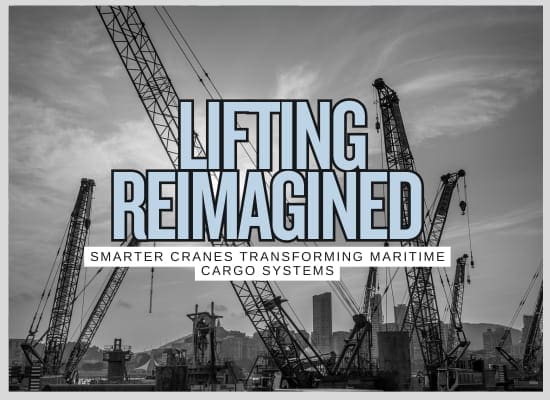
Beneath the steel bones of modern cargo ships, a quiet revolution is unfolding. It’s not in the headlines or splashed across trade shows, but in the cold precision of a crane arm that adjusts mid-lift without human input, in software that sequences cargo placement better than any veteran planner, and in experimental rigs that may someday repair themselves or work together like a mechanical swarm.
This isn’t science fiction; it’s the unfolding future of autonomous and semi-autonomous cargo handling at sea. Some of these technologies are already bolted to the decks of offshore wind vessels and heavy-lift ships. Others are still blueprints on the edge of reality. But all signal a shift in how maritime logistics are handled, especially as ships become smarter, leaner, and increasingly automated.
In this report, we’ll break down the current landscape into three tiers —
🟢 Deployed
🟡 Emerging
🔵 Conceptual
— and highlight 10 ship crane technologies that are redefining how ships lift, move, and manage cargo in the 2020s and beyond.

Heave-compensated cranes are the backbone of offshore lifting, designed to neutralize the impact of wave motion and maintain steady cargo control even in unpredictable sea states. These smart systems use sensors and hydraulics to adjust in real time — and they're already in action on thousands of vessels.
⚓ Where They're Found:- Offshore supply vessels servicing oil rigs and wind farms.
- Subsea construction and cable-lay ships operating in deepwater.
- Heavy-lift ships transferring loads between vessels at sea.
- Gyro and motion sensors detect vessel heave, pitch, and roll.
- Hydraulic or electric winches auto-compensate in milliseconds.
- Smart logic modules anticipate movement based on wave patterns.
- Set-and-forget lift profiles reduce operator fatigue.
- Auto-synchronization with DP (dynamic positioning) systems.
- Optional semi-autonomous modes for precision sub-sea placement.
- Minimizes risk of dropped loads or failed transfers.
- Enables offshore work in more challenging sea conditions.
- Improves uptime for wind farm and energy projects.
- Strong growth tied to global offshore wind expansion and deep-sea infrastructure projects.
- Operators are upgrading aging cranes for smarter, safer operations in rougher waters.
- Regulations in cold-weather zones are accelerating demand for advanced motion-compensated systems.
Bottom line: Heave-compensated cranes aren't just tech upgrades — they're enablers of safe, efficient offshore operations in the world’s most volatile environments. Their blend of automation and precision makes them the foundation of any future-forward lifting strategy at sea.
Modern ships aren’t just floating steel — they’re data-driven cargo platforms. Integrated load management systems use onboard sensors, software, and real-time logic to optimize how cargo is placed, secured, and moved throughout a voyage. These systems dramatically reduce loading errors, wasted space, and safety risks.
⚓ Where They're Found:- RoRo and multipurpose cargo vessels handling mixed freight types.
- Short-sea and feeder ships operating in high-frequency regional routes.
- New-generation autonomous or semi-autonomous vessels with limited crew.
- Monitors live weight distribution, center of gravity, and hull stress metrics.
- Assists with auto-sequencing for loading and unloading by crane or ramp.
- Integrates with stowage planning software and ballast tank systems.
- Suggests optimal load placement based on vessel stability and ETA.
- Alerts crew when loading practices trigger unsafe imbalance zones.
- Future versions may directly interface with automated cranes and port AI.
- Reduces port time by pre-optimizing crane moves and ramp order.
- Improves fuel efficiency by trimming hull drag via balanced loads.
- Prevents costly fines or voyage delays due to incorrect cargo declaration or misplacement.
- Rapid adoption on newbuilds, especially short-sea container and RoRo vessels.
- Retrofits gaining traction as safety regulations tighten and ESG reporting grows.
- Seen as a critical layer for unmanned or digitally managed ship platforms.
Bottom line: Integrated cargo systems aren’t flashy — but they’re transformative. As ships move toward autonomy and data-driven routing, the ability to manage cargo with digital precision will become a baseline expectation, not an add-on.
Crane systems are beginning to see with their own eyes — or more accurately, with sensors, cameras, and LIDAR arrays. These emerging technologies aim to automate the targeting and alignment process during lifts, reducing human error and making cargo operations safer, faster, and smarter.
🛰️ Most Likely Deployment Zones:- Specialized offshore vessels handling irregular equipment or turbine blades.
- Heavy-lift ships involved in wind farm construction or salvage operations.
- Future container ships operating in smart port ecosystems with V2I sync.
- Uses LIDAR, depth cameras, or computer vision to identify cargo and align lifting gear.
- Continuously adjusts boom, winch, and spreader angles during lift positioning.
- May also identify obstacles, misalignment risks, or incorrect rigging setups in real time.
- Auto-alignment of crane head with minimal operator input.
- Target-lock functions for complex or delicate loads.
- Real-time machine learning improves with every lift — even in chaotic environments.
- Reduces lift setup time and guesswork, especially with irregular shapes.
- Minimizes swing, drift, and collision risks in high-wind or low-visibility conditions.
- Enhances performance during ship-to-ship or ship-to-barge transfers at sea.
- High interest from offshore wind and subsea installation markets.
- Container lines and terminal operators watching closely as smart port standards mature.
- Regulatory pressure on crane safety and insurance incentives may accelerate adoption.
Bottom line: Auto-grabbing tech gives cranes “eyes and instincts” — a major leap in load accuracy and operator safety. While still in early-stage use, this technology has the potential to eliminate one of the riskiest aspects of modern maritime lifting.
Working beneath the surface where visibility drops and pressure climbs, subsea manipulator arms are the robotic hands of deepwater operations. While still largely operator-controlled, new models are incorporating AI-assisted functions — enabling smoother, faster, and safer underwater tasks like pipe handling, valve turning, and structure repairs.
🛰️ Most Likely Deployment Zones:- Subsea construction and inspection vessels in oil & gas or telecom cable work.
- Wind farm installation ships handling anchoring and seabed stabilization tools.
- Rescue or salvage vessels conducting deepwater recovery operations.
- Hydraulic or electric robotic arms mounted on ROVs or cranes with multiple degrees of freedom.
- AI-assisted grip, torque, and motion memory reduce fatigue during repetitive tasks.
- Arms often come with interchangeable tools for cutting, grasping, welding, or scanning.
- Semi-autonomous modes allow for pre-programmed sequences (e.g., connector placement).
- Collision-avoidance logic helps reduce damage in low-visibility environments.
- Operators can “teach” the arm through simulation interfaces or motion recording.
- Enables faster, safer repairs and installations on complex underwater infrastructure.
- Reduces dive crew reliance and human exposure to dangerous depths.
- Delivers consistency for critical precision tasks like valve adjustments or anode replacements.
- High demand in offshore energy as subsea infrastructure expands and matures.
- Defense and telecom sectors exploring more autonomous deep-sea intervention tools.
- Future tie-ins with AI-piloted vessels and unmanned underwater vehicles (UUVs).
Bottom line: These robotic arms aren’t replacing divers — they’re extending what’s possible at the ocean floor. With more autonomy being layered in each year, they’re laying the groundwork for a future where deep-sea work can be done faster, smarter, and safer than ever before.
What if a crane could test every lift virtually—adjusting for wind, swell, ship motion, and weight distribution—before making a single move? That’s the goal of digital twin crane systems. By creating a real-time digital replica of both crane and environment, AI can run thousands of lift scenarios and choose the safest, most efficient strategy.
🛰️ Most Likely Deployment Zones:- High-spec offshore construction vessels handling complex or high-value loads.
- Autonomous or AI-assisted ships requiring predictive, low-risk lifting logic.
- Smart fleet platforms integrating digital twins for maintenance and planning.
- Combines sensor data from cranes, vessel systems, and weather feeds in real time.
- Builds a dynamic digital replica that simulates potential lift outcomes based on current conditions.
- Feeds optimized lift parameters back to the real-world crane interface.
- AI selects safest boom angles, lift speeds, and sequences in advance.
- Can auto-adjust lift plan mid-operation if conditions change suddenly.
- Paired with predictive maintenance to reduce downtime and stress fatigue.
- Reduces failed or aborted lifts caused by human misjudgment or changing sea states.
- Increases safety in high-risk environments by removing trial-and-error.
- Enables continuous learning and improvement across a vessel or entire fleet.
- Rising demand among advanced offshore fleets and naval architects building next-gen vessels.
- Ports and heavy-lift terminals exploring digital twin tech for synchronized crane operations.
- Widespread adoption likely tied to broader rollout of autonomous maritime systems.
Bottom line: Digital twin cranes are still rare — but the logic behind them is undeniable. In a future defined by AI-assisted shipping and remote operations, simulating every lift before it happens won’t be a luxury — it’ll be a requirement.
What if cranes on a ship could talk to cranes on land? Port-to-ship synchronization aims to create a seamless handoff between shipboard lifting systems and automated terminals. Using real-time data, 5G/V2I communication, and AI, this concept promises to shrink turnaround times and eliminate costly coordination delays.
🛰️ Most Likely Deployment Zones:- Autonomous feeder vessels operating in smart port corridors (e.g., Northern Europe, Singapore).
- Future container ships designed to self-unload with minimal human oversight.
- High-traffic short-sea terminals where efficiency and speed are mission-critical.
- Uses real-time communication between shipboard cranes and port-side infrastructure (V2I).
- Enables synchronized movements, auto-confirmation of lift slots, and coordinated cargo sequencing.
- Integrates vessel AIS, crane sensors, terminal operating systems, and traffic control protocols.
- Crane systems can "negotiate" priority lifts and adjust motion based on nearby equipment.
- Predictive algorithms suggest timing windows to avoid gridlock at peak hours.
- Future versions may include full no-touch loading/unloading on select routes.
- Reduces time at berth by eliminating idle moments between crane handoffs.
- Improves accuracy in cargo sequencing and prevents misrouting at ultra-busy terminals.
- Optimizes crew requirements — or eliminates them entirely — for short-haul automated ships.
- Major smart ports and terminal operators are actively exploring compatible infrastructure.
- Feeder and coastal shipping markets pushing hardest due to higher frequency of turnarounds.
- Full-scale rollout depends on broader maritime communication standards and AI trust frameworks.
Bottom line: When cranes can talk, the entire port ecosystem becomes faster, leaner, and smarter. This isn't just about efficiency — it's about building the connective tissue for autonomous shipping to thrive.
What if a crane head could reconfigure itself mid-operation to grip containers, coils, pallets, or even irregular shapes — all without human intervention? Multi-cargo adaptive spreaders aim to make this a reality. These modular spreaders can change configuration based on cargo type, weight, and shape, saving hours of manual adjustments.
🛰️ Most Likely Deployment Zones:- Multipurpose heavy-lift vessels transporting mixed project cargo.
- Short-sea ships handling variable freight on tight schedules.
- Floating logistics hubs in remote regions or offshore construction zones.
- Hydraulically or electromechanically adjusts grip patterns in real time.
- Uses AI object recognition to detect cargo type and suggest optimal hold points.
- Can toggle between container locks, cradle supports, and soft-grip arms.
- Instantly reconfigures based on input from cargo databases or onboard scanners.
- Communicates with the vessel's load plan to prioritize lift sequence.
- May include built-in weight sensors for double-verification during lift.
- Eliminates crane downtime due to manual spreader swaps between cargo types.
- Increases load versatility for ships operating in ports with limited handling gear.
- Reduces risk of improper grip on non-standard cargo.
- High interest from hybrid cargo vessels and offshore logistics platforms.
- Prototype testing underway by advanced equipment suppliers in the wind and defense sectors.
- Wider adoption depends on ruggedization and integration into existing crane systems.
Bottom line: Adaptive spreaders are the Swiss Army knife of maritime cranes — a flexible, intelligent solution for mixed-freight missions. In an era of modular shipping and dynamic cargo, adaptability isn’t just a luxury — it’s a competitive edge.
Need a crane, but only for one mission? Modular crane pods are designed to be portable, mountable, and temporary — transforming standard barges, flat decks, or even containerized logistics units into fully capable lift platforms. It's plug-and-play lifting for the maritime world.
🛰️ Most Likely Deployment Zones:- Remote construction zones or undeveloped island ports.
- Military or emergency relief operations using flat barges or temporary platforms.
- Flexible project cargo missions needing one-time crane capacity without a dedicated vessel.
- Self-contained crane modules that can be bolted, latched, or magnetically mounted to a deck.
- Often container-sized for easy sea or road transport to deployment site.
- Powered by onboard generator units or host vessel’s auxiliary systems.
- Basic models manually controlled; advanced units include semi-autonomous lift presets.
- Integration with portable load planning software for mission-specific setups.
- Potential future use in smart modular seabases or floating logistics clusters.
- Rapid deployment in areas lacking fixed infrastructure or purpose-built vessels.
- Maximizes the utility of flat-deck platforms, especially in low-frequency lift zones.
- Cost-effective for short-term operations — no need for full crane ship charters.
- Growing demand in disaster response, humanitarian aid, and pop-up port logistics.
- Also gaining interest from military engineers and Arctic/remote exploration teams.
- Adoption hinges on ruggedization, safety certification, and standard mount configurations.
Bottom line: Modular crane pods give maritime operators the freedom to lift when and where they need — without overcommitting capital. As remote projects and floating base concepts expand, mobile lifting solutions are ready to meet them offshore.
What if, instead of one giant crane, a team of smaller robotic lifters worked together like a swarm of drones? Swarm-crane systems imagine a future where multiple coordinated mini-lifters distribute weight, adapt to odd-shaped cargo, and self-organize to complete complex lifts — all with AI-driven cooperation and redundancy.
🛰️ Most Likely Deployment Zones:- Floating logistics hubs or modular offshore assembly platforms.
- Military forward operating bases and mobile shipbuilding environments.
- Futuristic vessel types with AI-managed onboard automation frameworks.
- Each mini-crane unit is self-propelled and equipped with real-time load sensing and positioning controls.
- Units communicate continuously to balance load, adjust grip, and maintain synchronized motion.
- System learns from prior lifts to optimize future swarm patterns and reduce strain.
- Fully autonomous coordination of 3–12 units per lift cycle depending on cargo complexity.
- Path-planning AI prevents entanglement, collision, or drift during simultaneous moves.
- Fallback protocols allow the swarm to re-balance if one unit fails mid-operation.
- Enables precise handling of oversized or irregular cargo shapes without custom rigging.
- Increases safety through redundancy — no single point of failure.
- Scales dynamically: one ship can deploy only what’s needed per job, saving power and wear.
- Still theoretical, but of interest to navies, offshore R&D labs, and automated yard developers.
- Could be game-changing for temporary maritime factories, floating wind installations, or spaceport-at-sea concepts.
- Development depends on breakthroughs in compact power units, AI control systems, and maritime-certified mobility platforms.
Bottom line: Swarm crane teams are pure maritime sci-fi — for now. But in a future of modular vessels, remote construction, and automated everything, this could be the most flexible lifting system the ocean has ever seen.
Cranes take a beating — from load stress to saltwater corrosion. Now imagine if the components themselves could sense damage and begin repairing it automatically. Self-healing materials, already tested in aerospace and automotive, could soon make their way into the maritime lifting world, offering longer lifespans and safer operations with far less maintenance.
🛰️ Most Likely Deployment Zones:- High-cycle crane assemblies in offshore wind, container, or military ops.
- Critical failure points like hydraulic seals, cable sheaves, and boom hinges.
- Unmanned ships or remote installations with limited service access.
- Uses advanced polymers, shape-memory alloys, or embedded microcapsules that react to strain or cracks.
- Repairs may occur via chemical healing, structural re-bonding, or heat-activated reshaping.
- Some materials are “smart” enough to self-report their wear status to monitoring systems.
- Paired with sensors, these materials can trigger alerts or shutdowns before critical failures.
- Can extend maintenance intervals by actively reducing damage between service calls.
- Eventually may work in tandem with AI systems to optimize crane use and life cycle predictions.
- Minimizes catastrophic failures from unseen fatigue or corrosion.
- Reduces the need for manual inspections in hazardous or hard-to-reach areas.
- Increases crane availability and reduces total ownership cost.
- Still in R&D stage for maritime — but aerospace success is driving interest.
- Future adoption will depend on regulatory approval and material cost reductions.
- Likely to appear first in niche defense, offshore wind, and space-launch-at-sea platforms.
Bottom line: These materials won’t just make cranes smarter — they’ll make them last longer. As remote operations and unmanned ships expand, self-healing systems may become the hidden backbone of low-touch, high-performance maritime engineering.
From hydraulically stabilized cranes riding out storm swells to vision-guided grabbers and modular pods that can bolt onto a barge, the crane is no longer just a mechanical arm — it’s becoming a smart, adaptive system at the heart of maritime evolution.
Some of these technologies are already shaping daily operations offshore. Others are on drawing boards or in testing tanks, quietly preparing to redefine how we build, move, and maintain the infrastructure of global trade.
Whether you're upgrading a single vessel or planning the next-generation fleet, one thing is clear: the future of maritime lifting isn’t bigger — it’s smarter.
The smartest shipowners and operators are already looking beyond the crane itself — and toward the ecosystem of data, automation, and flexibility it now represents.