
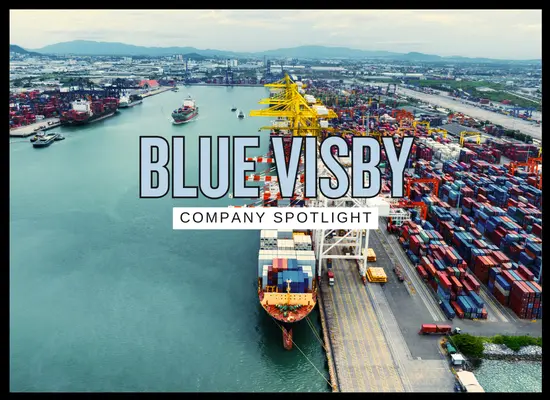
Blue Visby tackles one of shipping’s strangest habits: sailing fast to port just to sit at anchor. Through a coordinated arrival platform that tells ships how much they can safely slow down without losing their place in line, the Blue Visby Solution targets roughly 10 to 20 percent fuel and CO₂ savings without touching hulls or engines, using shared data, algorithms and a multilateral contractual framework that owners, charterers and ports can join together.
London EC3R 7AE, United Kingdom
- Cutting fuel and emissions without retrofits: Prototype trials on bulkers and LPG carriers reported average greenhouse gas savings in the mid teens to high twenties percent range, achieved only by coordinated speed reduction and adjusted arrival windows, not by changing machinery.
- Treating waiting time as a fleet problem: The platform replaces sail fast then wait behavior with an algorithm that looks at all participating ships heading to a port and allocates staggered recommended arrival times, so each vessel can slow down without losing its turn.
- Keeping contracts and risk positions intact: Blue Visby is built as a multilateral contractual and technological framework, designed to sit alongside voyage charters, COAs and port arrangements so that speed instructions and benefits can be shared without tearing up existing forms.
- Reducing congestion and idle time at anchor: By smoothing the arrival pattern, ports and terminals see a more predictable sequence of inbound ships, which can ease congestion risk and reduce safety concerns linked to crowded anchorages.
- Unlocking verified emissions numbers: External assessments have validated the methodology Blue Visby uses to estimate its impact, which matters if owners want to reference these savings in internal abatement curves, lender reports or sustainability disclosures.
- Creating a neutral coordination layer: The Blue Visby Solution is set up as an independent multilateral platform instead of a tool tied to a single line or port, so different owners, charterers and terminals can join the same system rather than each building their own.
- Positioning fleets for future operational rules: If regulators or cargo owners push harder on operational efficiency, having a fleet already used to coordinated arrivals and shared data gives a practical head start compared with ships that still treat every voyage as a solo sprint.
- Getting a clear picture of the opportunity: Case studies, consortium trials and explanatory material are available on the Blue Visby site for operators who want to see assumptions and results in more depth before running their own pilots. Visit bluevisby.com .
-
Prototype trials on bulker pair Safety4Sea / Smart Maritime NetworkSafety4Sea and Smart Maritime Network report on Blue Visby prototype trials with two CBH Group bulk carriers, highlighting CO₂ savings in the high teens on average and describing the trials as a practical test of sail fast then wait mitigation. Read the Safety4Sea article and the Smart Maritime write up .
-
LPG tanker trials with Marubeni Offshore EnergyOffshore Energy covers second stage prototype trials on LPG tankers under Marubeni charter, noting projected fuel and GHG savings close to thirty percent on voyages where Blue Visby recommendations were followed. Read the Offshore Energy piece .
-
Independent methodology validation Bureau VeritasBureau Veritas publishes an independent review confirming the robustness of the methodology Blue Visby uses to estimate fuel and emissions savings from coordinated arrival time optimization. View the BV validation note .
-
Explainer on fixing sail fast then wait ThetiusA Thetius explainer on port arrival optimisation uses Blue Visby as the main case study, emphasising that its contractual architecture is designed to sit alongside standard charters and share benefits between owners and charterers. Read the Thetius explainer .
-
Platform overview and efficiency framing Maritime CyprusMaritime Cyprus offers a narrative overview of the Blue Visby Solution as a multilateral optimisation platform, outlining how algorithms, real time data and collaboration are used to stagger arrivals and cut waiting time at anchor. Open the Maritime Cyprus feature .
-
Early consortium and concept coverage Splash247 / Smart Maritime NetworkEarly trade coverage from Splash247 and Smart Maritime Network introduces the Blue Visby Consortium and explains how its platform assigns target arrival times for groups of vessels heading to the same port. Splash247 launch story and Smart Maritime Network launch story .
| Category | Calculated value |
|---|---|
| Baseline fuel per voyage | 0 mt |
| Baseline fuel per year | 0 mt |
| Fuel saved per voyage | 0 mt |
| Fuel saved per year | 0 mt |
| Cost saved per voyage | $0 |
| Cost saved per year | $0 |
| CO₂ saved per year | 0 t |
| CO₂ saved per voyage | 0 t |
Blue Visby is interesting because it does not ask you to buy kit or redesign hulls, it asks you to look at the pattern of how your ships arrive and then coordinate speed in a way that still respects queues and contracts. A sketch like the one above is only a starting point, but if you plug in your own voyage counts, sea days and bunker prices it gives a quick feel for whether coordinated arrivals on your busiest routes are a marginal efficiency tweak or a material lever that deserves a pilot with charterers, terminals and ports in the same conversation.
We welcome your feedback, suggestions, corrections, and ideas for enhancements. Please click here to get in touch.