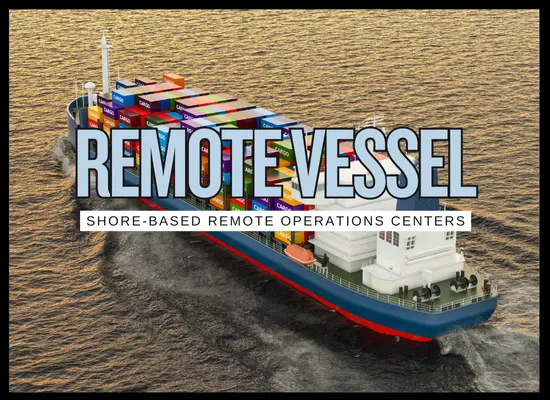
Remote vessel operations (ROC) is moving from “cool demo” to “managed operating model.” Going into 2026, the practical shift is that more projects are treating the shore-based Remote Operations Center as a real part of the safety case: defined roles, defined handover rules, connectivity assumptions written down, and a clearer regulatory runway for trials and early commercial use.
🎛️
What is it and Keep it Simple...
A Remote Operations Center (ROC) is a shore-based control room that can monitor a vessel, support decisions,
and in some cases take over defined functions for defined periods. Think of it as “shore bridge support”
that ranges from advisory oversight all the way to remote control, depending on the vessel concept and approvals.
In practice, ROC programs succeed when they are treated like an operating system, not a screen wall:
clear authority and handover rules, clear communications and fallback plans, and procedures that explain
exactly what happens when signals degrade or sensors disagree.
In plain terms
A ROC is a trained team ashore with a defined toolset (sensors, cameras, charts, comms, logs) that supports
safe navigation and operations. The key is not “remote driving.” The key is defined responsibility, defined limits,
and a documented plan for abnormal situations.
2026 Update
The IMO roadmap points to May 2026 for finalizing and adopting a non-mandatory MASS Code, with an experience-building
phase framework targeted for later in 2026. That timeline pushes more projects to formalize ROC roles, training,
cyber, and evidence collection now.
What you are really buying
A defined shore team workflow: watchstanding, escalation, handover, evidence logging
A connectivity and fallback plan that holds up in bad weather and busy waters
A safety case: what is remote, what is onboard, what is automated, and who is accountable
A governance layer: access control, change control, and incident playbooks
Remote Vessel Operations (ROC): Advantages and Disadvantages
Category
Advantages
Disadvantages
Notes / Considerations
Safety oversight
Adds an extra set of trained eyes and structured escalation during complex transits and abnormal operations.
Can create confusion if authority and handover rules are vague or disputed.
Define who is “in charge” by mode, and document when the ROC can intervene.
Operational efficiency
Faster troubleshooting, better coordination with shore teams, and more consistent execution of playbooks.
Efficiency gains vanish if the ROC becomes an extra approval layer or constant back-and-forth.
Keep ROC actions “exception-based” with clear triggers, not continuous micromanagement.
Connectivity dependence
Better connectivity can enable real-time support, richer situational awareness, and faster data exchange.
Link degradation can force sudden mode changes and raise risk if not planned for.
Write the degraded-mode playbook: what continues, what stops, and what switches to onboard autonomy.
Human factors
Shore watch teams can be built with specialized skills and consistent routines.
Remote operators can suffer from lower “feel” for the environment and information overload if displays are poorly designed.
Invest in display design, alert discipline, and simulation-based training for abnormal events.
Regulatory trajectory
Clearer IMO timelines support more structured trials and evidence-driven scaling.
Requirements can differ by flag, coastal state, and port authority, especially early on.
Treat approvals as route-by-route and operation-by-operation, not a one-time checkbox.
Cyber and access control
Centralized monitoring can improve logging, anomaly detection, and controlled remote support.
More remote connectivity increases the attack surface if identities, privileges, and change control are weak.
Enforce least-privilege access, MFA, segregated networks, and audit-ready logs.
Cost and scalability
A single ROC can support multiple vessels if scope is well-defined and tooling is standardized.
Labor, facilities, comms, and compliance overhead can be higher than expected.
Start with one or two “high-value” use cases (port approach support, remote diagnostics) before expanding scope.
Summary: ROC programs work best when they have a narrow, disciplined scope, strong governance, and a tested degraded-mode plan.
The main failure modes are unclear authority, unrealistic connectivity assumptions, and weak cyber / change control.
🧪
2026 ROC: What’s Really Working
1) A narrow scope with clear triggers
The strongest ROCs start with a few use cases: port approach support, abnormal-event troubleshooting, and remote diagnostics.
If everything is “ROC-managed,” it becomes noise and delay.
2) Authority and handover rules that are written down
Crews trust the ROC when escalation is predictable: who decides, what data is required, and what happens when the link degrades.
If those rules are vague, the ROC becomes a second bridge arguing with the first.
3) Connectivity assumptions that match reality
Working programs have a degraded-mode plan that crews can explain in one minute.
They know what continues, what pauses, and how the vessel returns to the safest operating mode.
4) Calm alerting and clean displays
The ROC cannot win if operators fight noisy alarms and inconsistent camera/sensor views.
The best centers keep alerts tight and require short, structured checklists for action.
5) Evidence becomes a KPI
Programs that scale track evidence: number of supported incidents, time-to-diagnosis, delay hours avoided,
and how often the degraded-mode plan was invoked.
6) Cyber and change control are not optional
Remote operations add remote access. Working programs use least-privilege access, strong authentication,
and audit-ready logs for every intervention and configuration change.
Fast “is it working” test
If the crew can name the ROC’s top three triggers, show a clean degraded-mode plan, and you can point to measurable
outcomes (fewer delay hours, faster troubleshooting, fewer repeat incidents), then it is working. If it feels like
extra approvals and messy alerts, it is not working yet.
ROC — Quick Value Snapshot (delay hours vs monthly cost)
Your baseline 3 inputs
ROC cost 2 inputs
This tool is intentionally simple: it answers one question fast —
“If ROC saves X hours per month, does it pay for itself?”
Monthly value from hours saved
—
Monthly total value (incl. other)
—
Monthly total cost
—
Net per month
—
Break-even hours saved / month
—
Annualized net
—
Quick read: if your break-even is under ~5–8 hours per month, ROC support is often easy to justify on vessels with complex port calls.
If break-even is 20+ hours, either the ROC cost is too high for the scope or your “hour value” assumption is too low/high and needs reality checks.
ROC programs are paying off when they reduce real friction: fewer delay hours, fewer repeat problems, and fewer expensive dispatches because the shore team can diagnose, document, and guide action quickly. Going into 2026, the fleets that look “ready” are the ones with a tight scope, clear authority and handover rules, a proven degraded-mode plan, and audit-ready logs of what the ROC did and why.