Mythos AI Review: Bridge Intelligence for Real-World Navigation
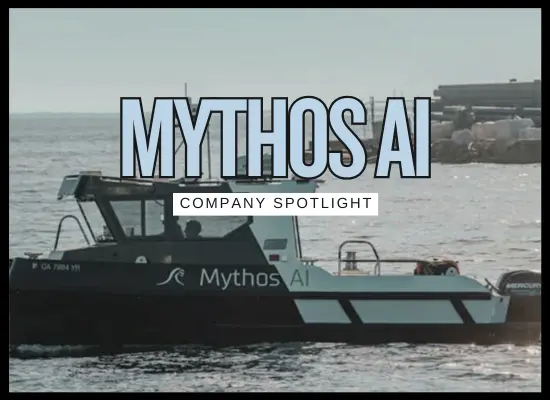
Mythos AI is betting that the bridge can be made safer and less workload-heavy without ripping out existing systems. Their focus is autonomy-augmented navigation: software that fuses sensors, highlights what matters in the channel, and supports more consistent decision-making for crews, operators, and OEMs across everything from inland towboats to autonomous surface vessels.
- Lower bridge workload in complex waterways by consolidating radar, AIS, and optical inputs into a single situational model, rather than forcing crews to interpret fragmented screens.
- Decision support that is meant to assist pilots and masters, not replace them, with bridge overlays that prioritize relevant traffic and hazards.
- A path to autonomy for unmanned and optionally crewed programs through software licensing that is positioned for both newbuild and existing platforms.
- Navigation behavior designed around COLREGs compliance and predictable vessel actions, which matters when you are trying to scale beyond one prototype boat.
- Command and control tooling for mission planning, real-time monitoring, and managing multiple vessels, aimed at reducing how many hands it takes to supervise operations.
- Survey and waterway workstream automation via MHydro, described as a standalone hydrographic autonomy package with drivers for common survey sensors and spec-based coverage.
-
Listed on a16z American Dynamism 50 (AI Edition) Andreessen Horowitz • 2024Mythos AI is included in a16z’s American Dynamism 50 (AI Edition), framed around automated marine shipping, self-driving vessels, and AI-powered maritime mapping. Reference: The American Dynamism 50: AI Edition .
-
Port of Monroe pilot: mapping berths and anchorages Newlab • 2025Newlab describes an 8-week pilot with Mythos AI at the Port of Monroe to map berths and anchorages and build a digital twin, positioned as a step toward more automated and lower-emission marine shipping. Post: Mythos AI and Newlab pilot write-up .
-
Selected for Gulf Blue Navigator cohort University of Southern Mississippi • 2024USM’s announcement lists Mythos AI among selected startups for the Gulf Blue Navigator program, focused on blue-technology validation and regional access. Release: Gulf Blue Navigator cohort announcement .
-
APAS installed on an inland towboat (Mississippi River) WorkBoat • 2025WorkBoat reports Mythos AI completed the first installation of its Advanced Pilot Assist System (APAS) on a Southern Devall towboat, aimed at improving safety and reducing costly navigation incidents. Coverage: Southern Devall and Mythos AI test APAS .
-
Tanker trial: APAS deployed aboard CB Pacific Splash247 • 2025Splash247 reports a year-long trial with CB Tankers and lomarlabs, describing APAS as radar-first with prioritised alerts to reduce bridge distractions and support decision-making. Article: Lomar taps pilot-assist tech for tanker trial .
-
Partnership with Ocean Power Technologies for autonomous platforms GlobeNewswire • 2025GlobeNewswire reports OPT partnering with Mythos AI to integrate autonomy software across OPT’s WAM-V ASVs and PowerBuoy platforms, with initial demonstrations referenced for Q1 2026. Release: OPT and Mythos AI partnership announcement .
-
MNAV product launch (unmanned vessel autonomy) PR Newswire • 2025PR Newswire carries Mythos AI’s announcement of MNAV, positioned as an autonomy system for unmanned surface vessels. Release: Mythos AI launches MNAV .
| Category | Value |
|---|---|
| Annual system cost | $0 |
| Total transits (all ships) | 0 |
| Total delay hours (baseline) | 0 |
| Annual fuel spend (baseline) | $0 |
| Expected incident cost (baseline) | $0 |
| Payback (months) | — |
| Workload check: hours saved (annual) | 0 |
If you’re evaluating Mythos AI as a potential client, the practical test is whether their stack fits your operating reality: your waterways, your radar and bridge workflow, and the types of delays and navigation risks that actually show up in your logs. The best next step is usually a scoped pilot with clear success metrics (delay reduction, near-miss trends, usability on the bridge, and any class or insurer feedback) so the adoption case is based on your own data rather than generic claims.
We welcome your feedback, suggestions, corrections, and ideas for enhancements. Please click here to get in touch.