France Just Boarded “Boracay”: A New Phase of On-Water Enforcement
🔔 Subscribe to ShipUniverse Weekly →
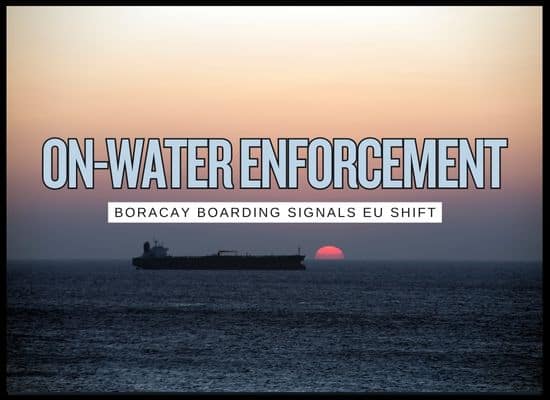
France’s boarding of the Benin-flagged tanker Boracay off Saint-Nazaire marks a shift from list-based sanctions to on-water enforcement. Two senior crew were detained, prosecutors in Brest opened a judicial probe, and President Macron publicly tied the ship to Russia’s “shadow fleet,” with some reports noting possible links to recent drone incidents over Denmark. For owners and charterers, this is the live template of what EU-side checks now look like at sea and at berth.
Judicial probe active
Off Saint-Nazaire, Atlantic coast
French Navy & Brest prosecutor
Sep 30 – Oct 1, 2025
| Area | Observed in case context |
|---|---|
| Nationality / flag | Requests to justify nationality; reported Benin flag; prior renamings/reflags reviewed. |
| Cooperation | Questions over cooperation and identity verification for senior crew. |
| AIS identity | Continuity checks; potential spoofing or mismatches against historic identifiers. |
| Documentation set | Registry extract, insurance & class status, ownership/ISM manager chain. |
| Security context | Regional security events referenced for risk triage (no confirmed causal link). |
| Document / check | Operational purpose |
|---|---|
| Same-day registry evidence (CSR) | Counter rapid reflagging and identity drift before services. |
| DOC, class, P&I confirmations | Gate for pilots, towage, bunkers, and terminal access. |
| AIS continuity & gap rationale | Explain dark periods; confirm identity integrity. |
| Ownership & manager history | Expose layered or rapid control changes. |
| Last 3 ports & cargo origin | Support sanctions screening for origin and end-use. |
| Basis | How it shows up on the water |
|---|---|
| Port State Control | Verification of certificates, class, registry, and safety; authority to detain for deficiencies. |
| Sanctions regimes | Checks for listed vessels/parties; service bans (insurance, finance, class) ripple into port access. |
| National criminal law | Judicial probes into false identity, document fraud, or non-cooperation. |
| Maritime safety/security | Enhanced screening where activities intersect with regional security concerns. |
| Event | Relevance to “Boracay” |
|---|---|
| EU/UK vessel listings expansion | Raised screening intensity for identity, registry, insurance. |
| Physical checks at EU ports | Movement from list checks to document-in-hand verification at berth. |
| Asia port rules on aging/opaque hulls | Converging standards: age, IMO integrity, valid class/insurance. |
| If this is true… | Ports commonly do… |
|---|---|
| Recent rename or reflag | Demand dated change log + registry letters before service. |
| AIS gaps or mismatches | Request continuity logs and explanations; possible hold pending review. |
| Unclear insurance/class | Refuse pilots/bunkers until proof received from issuer. |
| Opaque ownership chain | Ask for owner/ISM attestations; run enhanced KYC/KYV. |
| Sanctions-proximate counterparty | Escalate to legal/compliance; may deny services. |
| Risk factor | Potential impact |
|---|---|
| Identity drift (rename/reflag) | +1–2 days at anchorage for document validation. |
| AIS anomalies | +0.5–1.5 days while tracks and records are reconciled. |
| Insurance/class uncertainty | Service refusal until issuer confirmation; risk of cancellation. |
| Listed counterparties | Denial of entry/services; rerouting costs and delay. |
What triggered the boarding?
Is there a confirmed link to drone activity in Denmark?
Does this mean all high-risk tankers will be detained?
Which documents most often stall a call?
Will non-EU ports copy this approach?
What’s a reasonable “same-day” evidence bundle?
The Boracay operation illustrates how fast EU enforcement can move from list checks to physical verification when identity or documentation is in question. With prosecutors active and political attention high, expect more real-time requests for nationality proof, registry and insurance confirmation, and AIS integrity. Keeping those records current and accessible tends to correlate with smoother port calls while this case proceeds and similar actions emerge across the region.
We welcome your feedback, suggestions, corrections, and ideas for enhancements. Please click here to get in touch.