8 Vessel Upgrades With the Fastest Payback in 2026
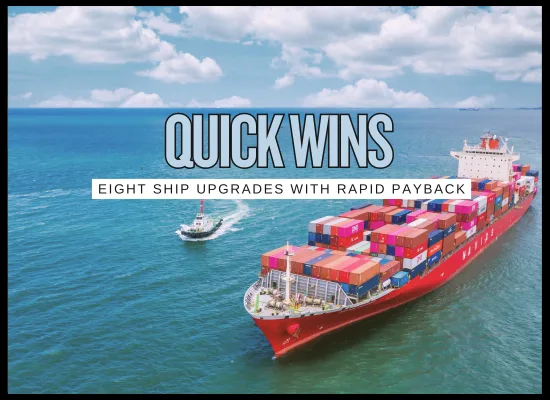
Shipping margins tighten fast when fuel and carbon costs move. If you’re ranking 2026 upgrades by “how quickly does this pay itself back,” start with changes that cut drag and restore propeller efficiency. The fuel saved shows up immediately, and on EU-linked voyages it also trims allowance spend, so every tonne avoided reduces two bills.
Click for 2-minute summary
| Upgrade | What it is (plain English) | Typical saving | Cost tier | Payback | Best fit | Key cautions |
|---|---|---|---|---|---|---|
| 1) Optimized propeller (re-pitch / reblade) | Re-match prop geometry to real trading speed and wake to lift thrust at the same power. | 3–6% | Mid | Months–2 yrs | Ships with stable service speed | Check cavitation margin; vendor or model study recommended. |
| 2) High-performance foul-release hull coating | Slick topcoat keeps the hull smoother and slows fouling so resistance stays lower between dockings. | 6–12% | Mid | Months–2 yrs | High sea-day trading | Plan surface prep; results depend on uptime and cleaning plan. |
| 3) Trim, speed & weather-routing optimisation | Software and sensors suggest best RPM, trim and route for today’s conditions; savings appear next voyage. | 6–12% | Low | Weeks | Any vessel with steady sea days | Needs crew adoption and reliable data (noon or meters). |
| 4) Propeller Boss Cap Fins (PBCF) | Fins on the boss cap cut hub-vortex losses and smooth the slipstream to raise prop efficiency. | 3–7% | Mid | Months–1 yr | Most prop-driven cargo ships | Verify alignment and cavitation; confirm with sea trials. |
| 5) Pre-swirl / wake-conditioning ducts | Steel duct ahead of the prop cleans and pre-swirls inflow so rotational losses fall. | 4–8% | High | ~1–3 yrs | Bulkers / tankers | Requires vendor study, structural fit and tuned installation. |
| 6) VFDs on major pumps/fans | Variable speed replaces throttling; cube law means small RPM cuts deliver large kW cuts. | ~1–3% vessel (20–50% on the load) | Mid | Months–2 yrs | SW/CW pumps, HVAC, ER fans | Check motor/drive compatibility, harmonics, control logic. |
| 7) Air-lubrication systems (ALS) | Micro-bubbles form an air carpet under the flat bottom to lower skin-friction drag. | ~3–6% net | High | ~2–5 yrs | Wide, flat bottoms at steady speed | Net = gross saving minus compressor power and O&M. |
| 8) Shaft generator / PTO (with converter) | Use the main engine to make electricity at sea and shut auxiliaries; converter keeps power in spec. | ~1–3% vessel | Mid | ~2–5 yrs | High hotel loads, many sea days | Works only if ME g/kWh delivered beats genset SFOC. |
1️⃣ Proactive Hull Cleaning + Propeller Polishing Cost: Low
Drag from light fouling and a rough prop eats fuel. Clean hulls and polished wheels restore baseline efficiency fast, so savings start on the next voyage and compound over a tight cadence.
Mechanism & Purpose
Slime increases skin friction and rough bronze adds prop losses. A proactive hull program plus frequent prop polishing keeps resistance low and efficiency high between dockings.
Impact you can bank
- 1️⃣Prop polish: immediate 2–5% fuel cut when the wheel is smoothed.
- 2️⃣Planned hull cleanings: maintain ~5–16% gains depending on route and cadence.
- 3️⃣EU-linked legs: lower fuel burn also reduces allowance surrender.
Savings & Payback
2️⃣ High-performance foul-release hull coating (with tight biofouling program) Cost: Mid
Silicone and other foul-release systems keep the hull smoother for longer and make cleanings faster. Drag stays low, so fuel use drops and carbon costs fall on routes covered by EU ETS. Results are strongest on ships with many sea days and steady service speeds.
Mechanism & Purpose
Low-friction topcoats reduce roughness and slow slime attachment. The hull stays cleaner between ports, cleanings take less time, and resistance growth is slower between dockings.
Impact you can bank
- 1️⃣Fuel reduction on the same schedule and speeds, especially on long legs.
- 2️⃣Fewer and faster in-water cleanings when paired with a proactive program.
- 3️⃣Carbon benefit on EU-linked voyages from lower fuel burn.
Annual Savings & Payback
3️⃣ Trim, Speed & Weather-Routing Optimisation (sensor-backed) Cost: Low
Light-capex software uses noon reports, flow meters and live weather to suggest the best RPM, trim and route. Gains arrive on the next passage. In most fleets the combined effect of smarter speed, trim and routing delivers several percent fuel saving with week-scale payback.
Mechanism & Purpose
Optimisers minimise resistance and weather loss at today’s schedule. Small trim changes reduce hull wave-making; modest RPM changes move the engine into a better SFOC point; routing avoids adverse current and sea states that spike fuel.
Impact you can bank
- 1️⃣Trim guidance: ~2–4% at service speed when ballast/fuel load changes.
- 2️⃣Speed optimisation: ~3–6% by holding a more efficient RPM window.
- 3️⃣Weather-aware routing: ~2–4% by dodging heavy seas and head currents.
Annual Savings & Payback
4️⃣ Propeller Boss Cap Fins (PBCF) Cost: Mid
PBCF fits fins on the propeller boss cap to recover hub-vortex energy and reduce rotational loss. The retrofit is simple at dry-dock, proven on thousands of ships, and normally returns a steady several-percent fuel reduction across service speeds.
Mechanism & Purpose
The hub vortex behind a conventional prop wastes energy and can raise vibration. Finned boss caps straighten the slipstream and improve thrust. The effect is strongest on full-form hulls with a healthy wake and adequate cavitation margin.
Impact you can bank
- 1️⃣Fuel cut typically 3–7% at service speed once installed and aligned.
- 2️⃣Reduced pressure pulses can ease vibration and improve comfort.
- 3️⃣Works well with ducts and trim/routing tools; effects add rather than overlap.
Annual Savings & Payback
5️⃣ Pre-swirl / wake-conditioning ducts (e.g., Becker Mewis Duct) Cost: High
A pre-swirl duct sits ahead of the propeller to condition the wake and add a gentle counter-rotation. The prop then sees a cleaner inflow with less energy lost in swirl, so thrust rises for the same power. Results are strongest on full-form bulkers and tankers that run steady service speeds.
Mechanism & Purpose
The duct accelerates and straightens the boundary-layer flow into the prop and imparts a small pre-swirl that reduces rotational losses in the slipstream. It is a steel structure welded to the hull at dry-dock and tuned to the ship’s wake field.
Impact you can bank
- 1️⃣Fuel saving usually 4–8% at service speed after tuning and sea trials.
- 2️⃣Plays well with PBCF and trim/speed optimisation; gains are largely additive.
- 3️⃣Needs cavitation margin and a healthy wake; plan CFD and model test or vendor study.
Annual Savings & Payback
6️⃣ Variable-frequency drives (VFDs) on major pumps/fans Cost: Mid
VFDs match motor speed to actual demand. Throttling and dampers waste power because the motor still spins near full speed. Most pump and fan loads follow the cube law: drop speed 20% and power can fall by roughly 50%. On ships the big wins are sea-water cooling, chilled-water, engine-room and accommodation fans that run many hours.
Mechanism & Purpose
Speed control replaces valves and dampers. Power use tracks speed³ on variable-torque loads, so small speed cuts deliver large kW cuts. VFDs also reduce noise and wear from throttling, and help hold temperatures with steadier control.
Impact you can bank
- 1️⃣20–50% kWh reduction on the retrofitted motors when throttling is replaced.
- 2️⃣Lower auxiliary fuel burn and fewer CO₂ allowances on EU-linked legs.
- 3️⃣Best targets: SW cooling pumps, CW/chiller pumps, HVAC supply/return, ER fans.
Annual Savings & Payback
7️⃣ Air-lubrication systems (ALS) Cost: High
ALS injects a controlled sheet of micro-bubbles along the flat bottom so the hull rides on air, cutting skin-friction drag. Savings are strongest on wide, flat bottoms at steady service speeds. Compressors draw power, so the real result is the gross main-engine saving minus the compressor penalty.
Mechanism & Purpose
Air is fed through perforated plates or nozzles to form a stable carpet over the flat bottom. The air layer lowers viscous friction and may damp small-scale roughness effects. Control logic adapts flow to draft and speed to hold a stable film with minimum kW.
Impact you can bank
- 1️⃣Gross fuel saving typically 4–8% at service speed on suitable hulls.
- 2️⃣Compressor/blower load subtracts from the win; target high uptime and tuned flow.
- 3️⃣Pairs well with hull coatings and trim optimisation; gains are largely additive.
Annual Net Savings & Payback
Strong gains come from picking the right mix for your hull, trade, and speed profile, then sequencing them well. Start with fast, low-capex levers that pay immediately at sea and set a higher baseline for the rest. Plan the heavier retrofits for your next dry-dock so you capture additive effects across the propeller, wake, and hull. With clean data, disciplined operations, and EU ETS priced into every decision, it is realistic to lock in a double-digit cut in fuel and carbon costs over the next 12 to 24 months.
Next steps are simple and practical. Benchmark today’s fuel and power with a short logging campaign, short-list two or three upgrades with the shortest payback for your fleet, and get vendor studies where needed. Run controlled trials, measure before and after, and include off-hire, O&M, and carbon in the ROI. Keep the hull clean, keep the crew engaged, and revisit the numbers as fuel and EUA prices move. The result is a cleaner, cheaper ship that keeps the savings through real-world trading.
We welcome your feedback, suggestions, corrections, and ideas for enhancements. Please click here to get in touch.